The World’s Most Glamorous Creatures Have No Backbone—and They’re Taking Center Stage
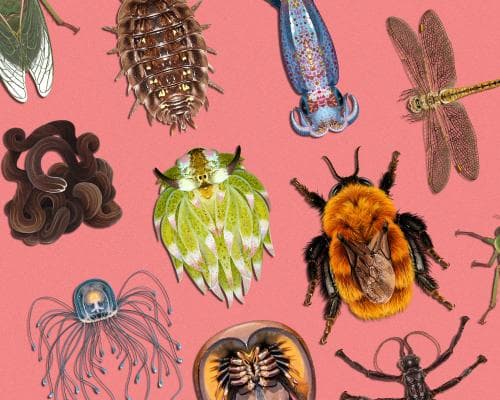
It’s raining in Melbourne, and the footpaths are ribboned with pale pink earthworms—soft, glistening streamers washed out of the soil by the storm. To most, they’re an inconvenience. To the discerning traveler, they’re a sign you’ve arrived somewhere alive. This is the world of the spineless, the 1.7 million species that crawl, flutter, and pulse beneath our feet and above our heads, and for the past year, they’ve had their own red-carpet moment: the Guardian’s invertebrate of the year contest. Forget the Oscars. This is where the real stars are.
The contest, now in its second year, is a celebration of the weird, the wonderful, and the woefully overlooked. More than 1,300 readers nominated their favorites—a weevil-worthy shortlist that has been whittled down to ten finalists. Among them: Bombus dahlbomii, a Patagonian bumblebee the size of a child’s thumb, cloaked in fiery orange fur, drawn to red flowers like a couture client to a rare Hermès silk. Then there’s the colossal squid, the heaviest invertebrate on Earth, a deep-sea phantom that could give any yacht’s hull a run for its money. And let’s not forget Milnesium tardigradum, the microscopic water bear that survived last year’s crown—a creature so resilient it can endure the vacuum of space, which is more than can be said for most frequent flyers.
For the luxury traveler, this is an invitation to recalibrate. The ultra-wealthy have long chased the big five on safari, the great whales of the Southern Ocean, the tigers of Kaziranga. But the new frontier is smaller—and infinitely stranger. Consider the Patagonian bumblebee, a species that thrives in the wind-scoured valleys of the Andes, where the air is thin and the flowers are the color of embers. A bespoke expedition to see it might involve a private estancia stay, a horseback ride through lenga forests, and a guide who knows exactly which red blooms the bee prefers. It’s not about the size of the creature; it’s about the rarity of the encounter.
This is where luxury travel meets conservation in a way that feels both urgent and indulgent. The contest isn’t just a popularity poll; it’s a reminder that biodiversity news is often devastating, and invertebrates are the silent workers who recycle our waste, pollinate our crops, and filter our water. They are the unseen infrastructure of every Eden on Earth. For the traveler who has seen the Galápagos tortoises and the polar bears, the invertebrate world offers a new kind of exclusivity—a secret society of species that most people will never notice, let alone name. And naming, after all, is the first step to protecting.
The access is the thing. While the masses queue for selfies with penguins, the discerning few can book a private naturalist-led walk through Melbourne’s Royal Botanic Gardens after a rainstorm, when the earthworms emerge like pale pink calligraphy on the paths. Or charter a vessel to the deep waters off New Zealand, where the colossal squid lurks at 1,000 meters, a creature so elusive it was only first filmed in its natural habitat in 2004. These are not trips for the faint of heart; they are for the curious, the patient, the ones who understand that the rarest treasures are often the smallest.
What does this signal about the future of luxury travel? It signals a shift from the spectacular to the specific. The wealthy are no longer content with postcard views; they want stories that can’t be Instagrammed by someone else. They want to say, “I’ve seen the Patagonian bumblebee,” and mean it. They want to understand the difference between a tardigrade and a nematode, and why one can survive the vacuum of space while the other can’t. This is intellectual luxury, the kind that money can’t buy—but a well-connected travel designer can arrange.
So where do the wealthy go next? They go to the places where the invertebrates are—the cloud forests of Ecuador, the karst caves of Vietnam, the tidal flats of the Wadden Sea. They go with guides who carry magnifying loupes instead of telephoto lenses, and they come back with something more valuable than a tan: a sense of wonder. The invertebrate of the year contest is just the beginning. The real journey is the one that starts when you look down.