The Ultimate Collector’s Item: Samuel Beckett’s Secret German Diaries
Imagine holding a leather-bound notebook that once rested in the coat pocket of a genius—a man who would go on to redefine modern theater, yet who, in 1936, was just another traveler with a pen and a growing sense of dread. That’s the allure of Samuel Beckett’s six German diaries, now published in full for the first time by Suhrkamp, and they’re not what the literary world expected. For decades, we were told Beckett was a poet of pure despair, a man so lost in existential fog that he barely noticed the rise of Hitler. The complete diaries, however, reveal a different man: a sharp, sardonic observer who saw the apocalypse coming and wrote it down in a code of wit and defiance.
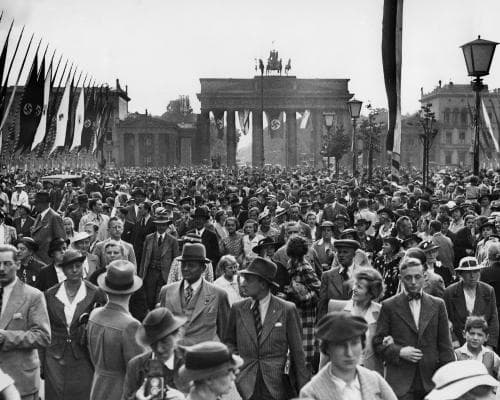
Beckett arrived in Hamburg in October 1936, a full three years before the war, but he didn’t need a crystal ball. He watched the crowds at Nazi rallies—the apoplexy, the braying, the collective hysteria—and noted with chilling prescience, “They’ll need to fight soon (or burst).” This is not the detached, melancholic Beckett we were sold. This is a man who collected the regime’s “holy phrases” in his notebooks—Führer, Bewegung, Blut und Boden, Freiheit und Ehre—not out of admiration, but as a kind of psychological trophy hunting. He even jotted down, in German, “Their Strength Through Joy conversation is killing me,” a private joke that would have been deadly if discovered. The man who would later join the French resistance was already waging a quiet war of observation.
What makes these diaries so extraordinary is the tension between what Beckett saw and what he dared to write. He was traveling through some 30 German cities—Hamburg, Berlin, Dresden, Munich—ostensibly to study art and perfect his German, his third language after English and French. But every page is a tightrope walk. As co-editor Mark Nixon, a professor at the University of Reading, points out, Beckett knew his notebooks could be confiscated at any border. So he developed a subtle rebellion: a parody of the Nazi salute by “sticking the wrong arm out,” a list of regime phrases that read like a collector’s catalog of horror, and a careful, coded disgust that he would only fully unleash in his later work. This is not pessimism; this is prudence under pressure.
For the ultra-wealthy, this publication is more than a literary event—it’s a rare artifact of intellectual courage, a window into a mind that refused to look away. The notebooks, now bound in a handsome edition, are the kind of object that belongs in a private library alongside first editions of Ulysses or a signed Picasso. They offer something that money can’t buy: a direct line to a moment when history hung in the balance, and one man chose to bear witness with a pen instead of a sword. The craftsmanship of the edition itself—Suhrkamp’s meticulous reproduction of Beckett’s handwriting, his marginalia, his sketches—makes it a tactile treasure, a conversation piece for dinner parties in Gstaad or a quiet evening in a Mayfair study.
But beyond the collector’s thrill, these diaries signal a shift in how we value cultural artifacts. We’re no longer satisfied with the polished public persona; we crave the raw, unvarnished truth, even if it’s messy. Beckett’s Germany is not the abstract landscape of Waiting for Godot—it’s a real place, with real dangers, and his account of it is a reminder that the greatest art is often born from the deepest engagement with the world, not escape from it. This is a lesson for today’s tastemakers: true luxury lies in authenticity, in the unedited, in the courage to see clearly.
As we look forward, these diaries will undoubtedly reshape Beckett scholarship, but they’ll also do something more intimate: they’ll invite us to reconsider our own role as witnesses to our times. For those who can afford it, owning this edition is not just a purchase—it’s a statement. It says you value the mind that dared to look, the hand that dared to write, and the history that we must never forget. And that, my friends, is the ultimate status symbol.
The Experience
Secure a first-edition copy of Beckett’s German diaries through a private rare-book dealer, or plan a curated literary tour of Hamburg and Berlin, tracing the playwright’s footsteps with a personal historian.