The Springboks' Ellis Park Loss Is a Warning to Investors: Dominance Without Innovation Is a Short Position
New Zealand's 33-16 dismantling of South Africa at Ellis Park reveals a brutal financial truth: capital (possession) without deployment (ambition) gets arbitraged. For wealth builders, the lesson is that market share and territory mean nothing without the creativity to convert them into returns.
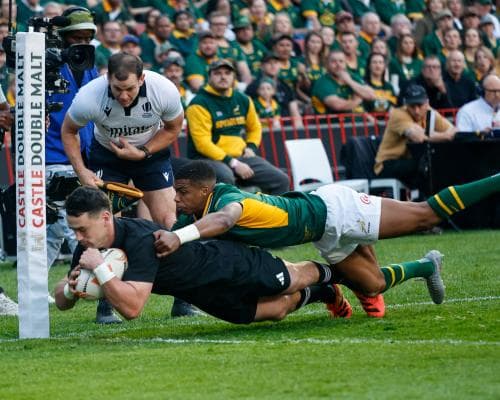
Forget the scoreboard for a second. The real story from Ellis Park wasn't a rugby match; it was a masterclass in capital misallocation. South Africa walked onto the most intimidating pitch in world rugby with 51% of the ball, 61% of the territory, and a scrum that bends steel. They lost by 17 points. If the Springboks were a portfolio, you'd be looking at a fund that held all the right assets, in the right sector, at the right time—and still managed to return negative alpha. The All Blacks didn't just win; they executed a hostile takeover of the game's most valuable real estate, and they did it with a fraction of the resources.
The numbers are the balance sheet, and they are damning. The Boks carried the ball 96 times to New Zealand's 83, made 286 post-contact metres to 191, and forced seven line-breaks—the same as the tourists. Yet they lost 23 turnovers to New Zealand's 13. That's a 77% higher rate of capital destruction. In market terms, South Africa was a conglomerate with huge free cash flow but terrible capital allocation. They kept buying back stock (box kicks) instead of investing in R&D (offloading, shifting the point of attack). The result? They generated massive 'territory'—which is just a fancy word for unrealized gains—but they couldn't convert it into earnings. They scored one try from that mountain of possession. New Zealand scored five from scraps.
The mechanics of the loss are a textbook case of the 'Innovator's Dilemma' playing out in real time. The Springboks' strategy was predicated on a single, historically reliable moat: the scrum and the physical collision. They assumed that sheer market share (possession) and field position (territory) would eventually crush the opposition's will. But New Zealand, led by a smarter, more agile deployment of resources, simply refused to engage in the capital-heavy war of attrition. They passed 124 times to South Africa's 106, moving the point of attack to find pockets of inefficiency. They absorbed the big hits—the sunk costs—and then used their speed to exploit the spaces left by South Africa's over-leveraged, heavy-asset approach. It’s the equivalent of a nimble tech startup outmaneuvering a legacy industrial giant that refuses to pivot.
For the wealthy, this is where the rarity and heritage angle comes into play. Ellis Park is a fortress; it has historically been a 'risk-free' bet for South Africa. The psychological premium of playing there has been priced into the team's equity for decades. New Zealand effectively shorted that premium. They ignored the narrative and looked at the underlying fundamentals: a Bok backline that was static, a game plan that was predictable, and a reliance on brute force that is easily arbitraged by speed. The All Blacks' victory wasn't just a win; it was a repricing of an asset class. The 'Ellis Park premium' is now in question, and the market (the rugby public, the bookmakers, and the squad itself) has to re-evaluate what South Africa is actually worth.
This signals a broader truth for investors and wealth builders watching from the sidelines: in a high-interest-rate environment, the cost of holding unproductive assets is brutal. South Africa held the ball for long periods, but that possession was 'dead money'—it didn't yield points. They were like a real estate developer holding vast tracts of land (territory) with no zoning approvals (tries). The turnover count of 23 is the equivalent of 23 failed deals. In today's market, where every basis point counts, you cannot afford to be the smartest person in the room if you're making the dumbest trades. The All Blacks showed that capital efficiency—not capital volume—is the ultimate indicator of wealth creation.
Looking ahead, the series is now a live trade. South Africa must go back to the drawing board, but the market is unforgiving. They have a week to restructure their balance sheet before the second Test. The question is whether they double down on their legacy strategy or pivot to a more dynamic model. As an investor, you should watch how they respond to this margin call. If they come back with the same game plan, they are signaling that they are a value trap. If they adapt, they might just be a cyclical recovery play. For now, the smart money is on New Zealand, who have proven that in the brutal arena of international competition, the only moat that matters is the one you build with your imagination, not your muscle. The Springboks had the capital; the All Blacks had the yield. The market has spoken. The better team won, and the better strategy made the better team. That's a lesson that trades well in any currency.