The New Windsor Set: How England's Women Are Rewriting the Currency of Dominance
There is a moment in every great dynasty when the scoreboard becomes irrelevant. When the result is a foregone conclusion, and the real spectacle is the architecture of the win itself. That moment arrived at New Road, Worcester, as the late afternoon sun threw cathedral shadows across the square and England's women closed out a third consecutive one-day international against Ireland with the sort of unhurried, almost dismissive efficiency that separates the merely excellent from the truly inevitable. This wasn't a victory. It was a statement of intent, delivered in the language of total control—a language the ultra-wealthy understand better than anyone. Because when you have already secured the prize, the only thing left to acquire is the manner in which you took it.
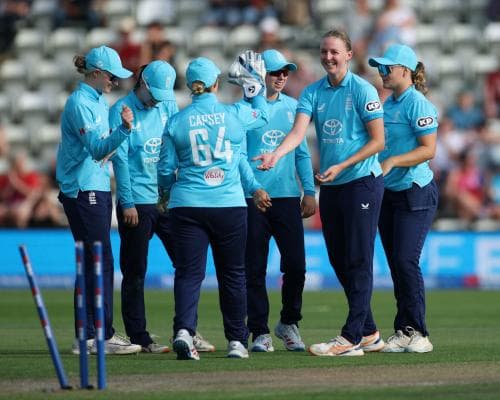
The numbers tell a story of brutal, elegant finality. England swept the series 3-0, but the final chapter was less a contest than a coronation. Ireland, chasing a modest total, lost their last five wickets for just ten runs in the space of 21 balls—a collapse that felt less like a failure of nerve and more like a recognition of the inevitable. Lauren Filer, the fast bowler with the kind of raw pace that makes scouts scribble notes in capital letters, splatted the stumps twice in two balls (the first, cruelly, was called back as a free hit; the second was a carbon copy, as if to prove the point). She finished with 3-27. Mady Villiers, the off-spinner who seems to collect wickets like other people collect frequent-flier miles, took 3-33. Tilly Corteen-Coleman chipped in with a brace. The bowlers were so deep that even captain Charlie Dean and Ryana MacDonald got in on the act. Ireland's chase was never going anywhere; England were never under pressure. It was, by any measure, a comprehensive dismantling.
But to read this as merely a cricket story is to miss the point entirely. This is a masterclass in the art of the roster—the kind of depth that money alone cannot buy, but that patient, obsessive investment in talent absolutely can. Look at the cast. Charlie Dean, the 24-year-old captain, has spent this summer proving she is the heir apparent to the great Nat Sciver-Brunt, a player whose very presence used to feel like a safety net. Now Dean is the net, and she's also the tightrope walker. Sophia Dunkley, who was named player of the match, player of the series, and player of the summer—a clean sweep of individual honors that mirrors her team's collective dominance—anchored the innings with a calm that bordered on nonchalance. Maia Bouchier provided the foil at the other end, the kind of supporting performance that doesn't make headlines but makes victories possible. And then there was the moment that had nothing to do with runs or wickets: the guard of honor for Arlene Kelly, the Ireland all-rounder, as she walked off for the final time. Both teams lined up to applaud her, the sun casting long shadows, and she walked through bashfully, a class act to the end. In an era of transactional sport, that gesture was the rarest currency of all: genuine respect.
What does this signal about wealth, taste, and the luxury market? Everything. The modern luxury buyer doesn't want a single masterpiece; they want a collection that works in concert. They want the quiet confidence of a team that doesn't need to shout because the results speak in a whisper that carries. England's women have built exactly that—a side where the sum of the parts is almost unfair, where the bench could start for most international teams, and where the captain's post-match comments sound less like a leader and more like a curator describing a flawless exhibition. "We left a few runs out there, to be honest," Dean said, with the kind of understatement that is the hallmark of true power. "But to come back and start with how we did with the ball was brilliant. The way the girls have gone about it, they have shown real maturity." Maturity. That's the word. It's the same quality that separates a first-growth Bordeaux from a supermarket blend, a bespoke Savile Row suit from off-the-rack, a private jet from a first-class seat. Anyone can buy talent. Maturity—the ability to execute without drama, to win without panic, to let the game come to you—that takes time, patience, and an unshakeable belief in the process.
Looking forward, the horizon is not just bright; it's blinding. Dean spoke of "really exciting times" and a desire to "extend that even further." Ireland's captain, Gaby Lewis, offered the perspective of a worthy opponent: "Every series against these top quality players they'll learn. A good build into the winter. These series are so valuable." But the real target is already in view. Dunkley let it slip with the kind of casual candor that makes her so compelling: "It's a big summer with the Ashes next year and it is one of my goals to stay at the top of the order." The Ashes. That's the trophy that matters, the one that will define legacies and fill the highlight reels. And if this summer's sweep is any indication, England's women are not just ready for that challenge—they're already planning the celebration. The scoreboard at New Road may have read England 3-0 Ireland, but the message was aimed far beyond Dublin. It was a note to Australia, to the world, and to anyone with the taste to recognize it: this is what dominance looks like when it's done with style. And it's only just beginning.
The Experience
To witness the next chapter of this dynasty, secure your place at a future England women's international through the ECB's premium hospitality packages—or, for the truly committed, plan your travel around the 2026 Ashes tour and watch history unfold from the best seats in the house.