The New Power Play: When Protest Becomes a Status Signal
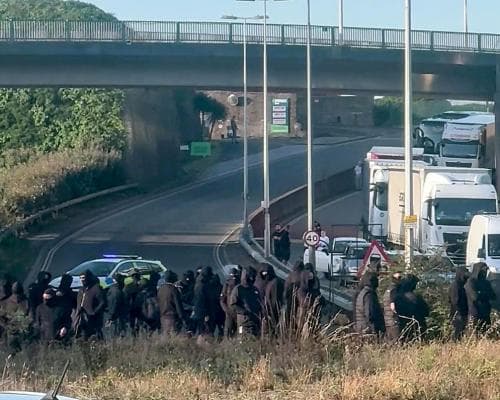
On a grey Saturday morning, the kind that usually belongs to private jets and quiet departures, the Port of Dover became the stage for a very different kind of theatre. Dozens of figures in black, faces obscured by balaclavas, linked arms across the A20, halting the flow of lorries and luxury coaches alike. For the ultra-wealthy, who measure time in minutes and convenience in miles cleared, this was more than a disruption—it was a raw display of power. Not the power of capital, but the power of chaos, wielded by those who have nothing to lose and everything to prove. And in that moment, the port—a gateway to the Continent's playgrounds—became a mirror of a world where order is a luxury few can afford to lose.
The scene unfolded with a precision that belied its grassroots origins. Videos shared across social media showed masked protesters marching in lockstep, chanting slogans that echoed off the glass facades of waiting ferries. Kent police arrived, but made no arrests, a fact that spoke volumes about the delicate dance between authority and anarchy. By lunchtime, the protesters had dispersed, leaving behind four miles of congestion and delays of up to 30 minutes—a mere blip for the average traveller, but an eternity for those whose schedules are choreographed to the minute. The Port of Dover called it a 'public order incident,' a euphemism that failed to capture the audacity of a group that claimed responsibility under the name Patriot Platform, a fringe collective with a penchant for theatrical defiance.
For the connoisseur of rare experiences, there is a certain irony in watching a protest that borrows the language of blockade—a tactic historically used by striking workers or revolutionary cells—and repurposes it for a cause that feels almost nostalgic in its nativism. The far-right activist Tommy Robinson, real name Stephen Yaxley-Lennon, amplified the event, urging his followers to 'get there to support them,' and boasting of '3 plus locations' shut down across Dover. But for the elite observer, the real spectacle was not the politics—it was the logistics. How do you coordinate a hundred masked individuals, synchronise their movement, and dissolve before the authorities can respond? That level of organisation, however crude, demands a certain respect. It is the same discipline that goes into staging a flawless auction at Christie's or orchestrating a private viewing at a Venetian palazzo—except here, the currency is not art, but attention.
The craftsmanship of disruption is an art form in itself. Consider the choreography: linking arms in a human chain across a major artery, chanting 'England till I die' with a fervour that borders on liturgical. It is a performance designed for the cameras, and the cameras obliged. Live streams drew thousands of viewers, each one a potential convert to a cause that thrives on visibility. For the wealthy, who often pay handsomely for privacy, this public spectacle is a reminder that the masses still crave the stage. The irony is not lost: while billionaires retreat to gated compounds and private islands, these protesters claim the public square as their own, turning a transit hub into a theatre of resistance. The Port of Dover, a chokepoint for trade and travel, became a canvas for a message that was less about immigration than about the sheer thrill of disruption.
What does this signal about the luxury market? Perhaps nothing directly, but everything indirectly. The ultra-wealthy are not immune to the currents of social unrest; they simply experience them from a distance, insulated by chauffeurs and chartered flights. Yet the Dover blockade is a reminder that even the most fortified lifestyles are vulnerable to the whims of those who choose to stop the clock. For the luxury traveller, the lesson is clear: true exclusivity is not just about access, but about the ability to bypass the fray. Private jet charters, helicopter transfers, and concierge services that reroute around chaos have never been more valuable. The protest may have dispersed, but its echo lingers in the boardrooms of private aviation companies and the algorithms of travel security firms, which now factor 'civil unrest' into their risk assessments with the same gravity as weather patterns.
Looking forward, the Dover incident is a harbinger of a world where disruption becomes a commodity, traded in the same markets as rare vintage cars or prime real estate. For those who can afford it, the ultimate luxury is not a yacht or a penthouse—it is the ability to move through the world untouched, unbothered, and unblocked. As the sun set over the White Cliffs, the port returned to its rhythm, but the memory of those masked figures lingered. They had proven that power is not always measured in net worth, but in the capacity to make others wait. And in a world where time is the only true currency, that is a lesson worth pondering over a glass of Krug, far from the fray.
The Experience
For those who prefer their travel uninterrupted, consider a private helicopter transfer from London to Le Touquet, bypassing Dover entirely—arrange it through your concierge before your next Channel crossing.