The Last Bear Pit: Dara Ó Briain on the Brutal Art of Making Smart People Funny
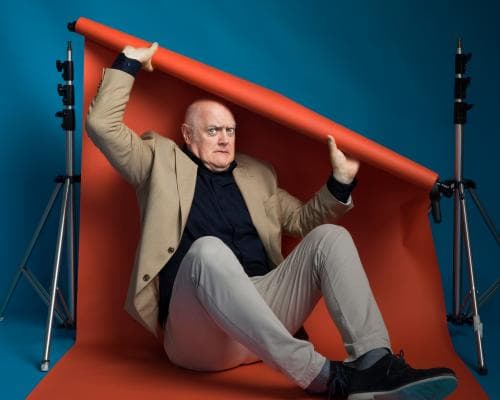
The photographer has Dara Ó Briain crouched on a studio floor, clutching a scroll of rust-colored paper as if the roof is collapsing on him. It’s a joke, of course—a comedian’s version of a power pose. But when he looks up and grins, you realize the real joke is on us: for two decades, this man has been the ringmaster of one of television’s last true gladiatorial arenas, and he’s only now getting the respect usually reserved for hedge fund managers. We walk to a pub up the road, because that’s where the real conversation happens. No velvet ropes, no private dining room. Just a man who has spent his career making the powerful squirm, and making the rest of us feel like we’re in on the secret.
The secret, it turns out, is that Mock the Week—the show Ó Briain has hosted since its 2005 debut—is back, reborn on TLC after a 17-year run on the BBC. It’s a resurrection that feels almost aristocratic in its defiance of the streaming age’s algorithm-driven homogeneity. The format is deceptively simple: two teams of comedians compete in a faux game show, answering questions about the week’s news. But the real product isn’t information—it’s the thrill of watching sharp minds spar in real time, with no safety net. Ó Briain, 54, calls it “a debutante’s ball for people who’ve gotten to the top at Edinburgh and are ready to go on screen.” Translation: this is where the next generation of comedy royalty is crowned. For the ultra-wealthy, who often pay six figures for a seat at a charity roast, this is the raw, unpolished version of that same adrenaline—minus the caviar.
But let’s talk about the cruelty, because that’s what separates the merely funny from the truly elite. The show was often accused of being vicious, mean, and male—a bear pit where comics elbowed each other aside for a jab. Ó Briain doesn’t defend it. “It was generally seven men around the table,” he admits, “they were trying to find themselves; there were elbows.” He wouldn’t have wanted to be a contestant. “I would have found it too stressful.” That honesty is rare in any industry, but especially in entertainment, where everyone is curating their brand. It’s the same candor that makes a Patek Philippe more valuable than a smartwatch: the willingness to show the mechanism, even when it’s ugly. The show’s politics leaned left, yes, but Ó Briain is quick to note that’s because the Tories ran the country for most of its run. “Nobody on Mock the Week was going: ‘Well, maybe sovereignty or whatever…’” He says it with a shrug, but the implication is clear: comedy, like wealth, is a form of power, and power always punches in a direction.
Here’s what the critics—and the snobs—miss. The show’s meanness was never random. It was a form of quality control, a Darwinian filter that ensured only the quickest wits survived. “Don’t mock the weak,” Ó Briain says, and you can hear the unspoken corollary: mock the strong, mock the comfortable, mock the people who deserve it. That’s a philosophy that resonates with anyone who has built a fortune from nothing. The luxury market understands this instinctively. A bespoke suit isn’t just fabric; it’s armor. A private jet isn’t just transportation; it’s a statement that you’ve transcended the queues of ordinary life. Mock the Week, in its new incarnation, offers something even rarer: the chance to watch people who have mastered their craft do something that cannot be faked. No script, no retakes, no safety net. Just pure, unadulterated wit.
So what does this signal about the state of luxury? It suggests that the ultra-wealthy are hungry for authenticity—the kind that can’t be bought, only witnessed. A Birkin bag is lovely, but it doesn’t make you laugh. A Bugatti is thrilling, but it doesn’t make you think. The revival of Mock the Week is a reminder that the most exclusive commodity in the world isn’t gold or rare whiskey—it’s the ability to be genuinely, dangerously funny in front of a live audience. Ó Briain has built a career on that, and he’s not done. As he says, the show is a debutante’s ball, and he’s still the host. For the rest of us, it’s a front-row seat to the last bear pit on television.
As the light fades in that west London pub, you get the sense that Ó Briain is less a comedian than a curator of chaos—a man who understands that the most valuable thing you can own is the ability to laugh at the powerful. In a world where everyone is selling you something, he’s selling nothing but the truth, wrapped in a punchline. And for the truly wealthy, that’s the one thing money can’t buy—but it can certainly watch.
The Experience
Book a private table at a live Mock the Week taping in London, or commission a bespoke comedy roast for your next boardroom retreat—where the only currency is wit.