The Kremlin Talks That Could Redraw Europe's Defense Map
US envoys met Putin in Moscow to discuss 'next steps' for ending the Ukraine war, signaling a high-stakes diplomatic push that could reshape European security and defense spending. The outcome hinges on whether Trump's team can bridge irreconcilable military goals with a fragile ceasefire.
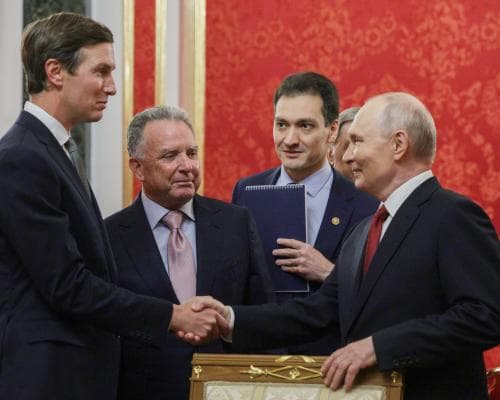
In a dimly lit Kremlin meeting room, the fate of Europe's post-war order is being negotiated not by generals but by envoys carrying briefcases full of 'ideas'. On Saturday, Donald Trump's representatives sat across from Vladimir Putin, discussing 'substantive plans for next steps' to end the war in Ukraine — a phrase that, in diplomatic terms, is code for something far more consequential than a ceasefire. The White House says these steps will be announced in 'coming weeks', and the envoys are already scheduled for equally productive talks in Kyiv on Sunday. But behind the careful language lies a brutal reality: Russia still believes it can seize the rest of eastern Ukraine, and Ukraine is adjusting its airspace operations in response to strikes on its capital's airports.
This is not just another round of peace talks. It is a high-stakes gamble by the Trump administration to impose a settlement on Europe's largest conflict since 1945, with billionaires and defense contractors watching every move. The meeting in Moscow, described by Kremlin aide Yuri Ushakov as 'extremely frank', saw the Americans propose 'a number of ideas' for a settlement — though details remain opaque. What is clear is that this is a power play that could redefine the security architecture of the continent, and the technology that underpins it. The stakes are immense: if a deal is struck, billions in defense spending will shift; if it collapses, the world's most advanced weapons systems will continue to be tested in real time.
The technology angle is as sharp as a drone's blade. Ukraine has closed its airspace since 2022, forcing officials to travel by train, but the recent Russian strikes on Kyiv and Boryspil airports were 'clearly' a reaction to the possibility of US negotiators flying in. Zelenskyy's response — vowing to adjust operations against Russian airspace 'because of our drones and missiles in the sky' — underscores how this war has become a live laboratory for autonomous warfare, electronic jamming, and satellite-guided strikes. The Kremlin's confidence in achieving its military goals is not just bluster; it reflects years of investment in electronic warfare and drone swarms, while Ukraine has countered with a nimble tech sector that has pioneered naval drones and AI-targeting software. Any peace deal will not just stop the shooting; it will freeze a technological arms race that has already leaked into global markets.
The capital behind this diplomatic push is as concentrated as the firepower. Trump's envoys are not career diplomats but loyalists with business backgrounds, reflecting an administration that views foreign policy through a transactional lens. The 'next steps' they discussed likely involve territorial concessions, security guarantees, and — crucially — the lifting of sanctions that have crippled Russia's economy but enriched its military-industrial complex. For the defense sector, this is a pivot point: if peace holds, Western arms makers like Lockheed Martin and Rheinmetall will see a drop in Ukraine-related orders, but a surge in European rearmament as NATO countries rush to rebuild depleted stockpiles. If talks fail, the opposite happens. Either way, the market is pricing in volatility, and the billionaires who fund both sides' tech startups are hedging their bets.
This is not a story about a single deal; it is a signal for the entire defense-tech ecosystem. The fact that Putin and Trump's envoys are meeting at all — while Ukraine strikes Russian airspace and Russia targets Kyiv's airports — suggests a new era of 'negotiated warfare', where diplomacy and combat operate in parallel. The three-day vow not to strike each other's capitals is a fragile pause, but it is also a precedent for how future conflicts might be managed: with calibrated escalation and tech-enabled messaging. For investors, the takeaway is that the 'peace dividend' of the 1990s is a relic. Today's peace is a commodity, bought and sold with missiles and microchips, and the next few weeks will reveal whether Washington can broker a deal that sticks.
Looking forward, the real innovation here is not in the weapons but in the process. The White House's promise of 'equally productive meetings' in Ukraine suggests a shuttle diplomacy that could become a template for other frozen conflicts — from Taiwan to the South China Sea. But the Kremlin's unyielding stance on seizing eastern Ukraine is a reminder that technology cannot solve political will. What happens in the coming weeks will determine not just the borders of Ukraine, but the rules of engagement for the next generation of warfare. If the envoys succeed, they will have done what billions in military aid could not: forced a pause in Europe's deadliest conflict since World War II. If they fail, the drones will keep flying, and the world will keep watching — and investing — in the tools of tomorrow's battles.