The Hidden Current: Why Global Tides, Not Local Politics, Are Rocking the World's Bond Markets
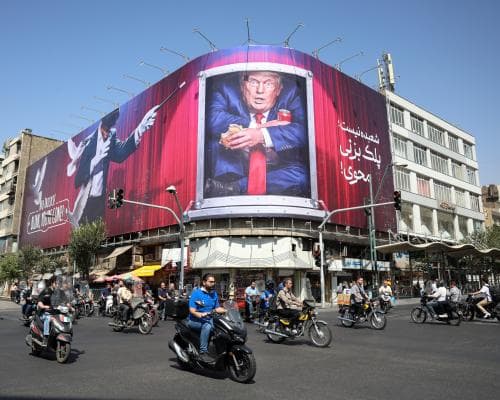
In the rarefied world of sovereign debt, where fortunes are made and lost on the whisper of a yield curve, the recent tremors have felt deeply personal. For the ultra-wealthy, whose portfolios are tethered to the health of nations, the question isn't merely 'why are markets falling?' but 'who is truly steering this ship?' The answer, as it so often is, lies not in the domestic headlines but in the geopolitical undercurrents that move billions with a single tweet. We've been here before—remember the chorus of 'global factors' during the Cameron-Osborne years, a convenient scapegoat for austerity's self-inflicted wounds? Now, the tune has changed, but the melody is hauntingly familiar. The real culprit, whispered in the corridors of power and shouted on trading floors, is the escalating 'Trumpkrieg' against Iran, a conflict that is sending shockwaves through every developed economy, yet is often relegated to the financial press's back pages.
The narrative being spun by much of the media is a convenient fiction: that the bond market's jitters are a uniquely British phenomenon, a referendum on a Labour government's fiscal prudence. This is a myopic view, a dangerous simplification that does a disservice to the discerning investor. The truth is far more global. Market alarm is widespread across the planet, a synchronized sell-off that transcends any single nation's budget. When the head of the Bank of England has to publicly calm nerves ahead of a crucial budget, the story isn't just about a spreadsheet in Whitehall; it's about a world where geopolitical risk has become the new normal. For those with significant capital, this is not a moment for partisan bickering—it's a moment for clear-eyed analysis, for understanding that the 'self-harming media coverage and Tory amnesic bellowing' is not just noise, but a distortion of the signal.
Let's talk about craftsmanship—not of a watch or a yacht, but of economic policy. The art of fiscal management in a globalized world is akin to navigating a superyacht through a storm. You can have the finest crew (or the most competent treasury), but if the wind and waves (global factors) are against you, the journey will be treacherous. The current turbulence is a masterclass in this dynamic. The UK's relatively high debt obligations are a serious challenge, no doubt, but to focus solely on them is to ignore the fact that the entire global fleet is battling the same squall. The real 'craftsmanship' lies in the perception, in the ability to see beyond the headlines and recognize that the market's anxiety is a shared, global condition, not a bespoke failure. This is the heritage of the modern financial era: a system so interconnected that a conflict in the Middle East can dictate the price of a gilt in London, a reality that demands a more sophisticated understanding than the daily tabloid fodder.
What does this signal about wealth and taste in the current climate? It signals a shift from the ostentatious to the strategic. The truly wealthy are not panicking; they are recalibrating. They understand that 'global factors' is not an excuse but a fundamental parameter of their investment thesis. The luxury, now, is in the information—in having a perspective that sees the whole board, not just the square in front of you. The media's self-harming coverage, which serves only to stoke domestic anxiety, is a disservice to the public and a distraction to the investor. It's like a fine wine critic who only reviews the bottle's label, ignoring the vineyard's climate and soil. The connoisseur knows the vintage is a product of its entire environment, and so is the bond market. The recent sell-off is not a commentary on any single government's 'austerity' or 'profligacy'; it is a global repricing of risk in a world that has become fundamentally more volatile.
Looking forward, the path is not for the faint of heart. The 'Trumpkrieg' and its economic aftershocks will not dissipate overnight, and the bond market's tremors will likely continue. For the sophisticated, this is not a time for retreat but for discernment. The opportunity lies in distinguishing between the noise of domestic politics and the signal of global economic realities. The next few months will test the mettle of finance ministers and investors alike. But for those who can see the world as it is—a complex, interconnected web of cause and effect—there is a quiet confidence. They know that while the headlines may scream of local failures, the true story is being written on a global stage, and the only prudent response is to read between the lines, to understand the currents beneath the surface, and to position oneself not against the tide, but in harmony with its inevitable flow. The era of easy explanations is over; the era of global awareness has begun.
The Experience
For a bespoke briefing on navigating global market volatility, consider a private consultation with a geopolitical risk advisor who can tailor strategies to your portfolio's unique exposure.