The Geopolitics of Deterrence: Why Trump's North Korea Gamble Redraws the Asian Security Map
Donald Trump's claim that Kim Jong-un has responded to his overtures—while scaling back US-South Korean military drills—signals a fundamental shift in deterrence strategy. This editorial analyzes how the move redefines the balance of power in Northeast Asia and what it means for the future of US alliances.
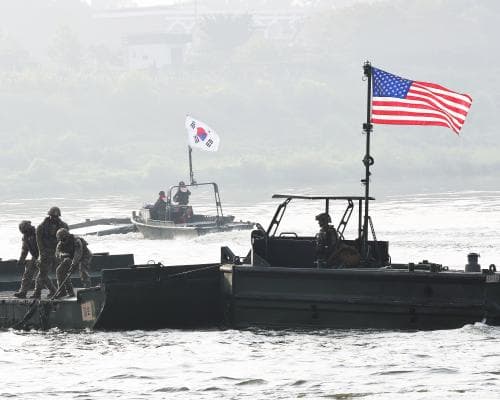
In the Oval Office, surrounded by the trappings of American power, Donald Trump dropped a bombshell that had nothing to do with the teenage lifeguard standing beside him. Asked about North Korea, he confirmed what his critics have long feared and his supporters have long hoped: Kim Jong-un has responded. The details are murky, the implications are not. By scaling back joint military exercises with South Korea—days after Pyongyang test-fired ballistic missiles—Trump is betting that personal diplomacy can replace the muscle memory of Cold War-era deterrence.
This is not a policy tweak. It is a paradigm shift. For seven decades, the US-South Korea alliance has rested on a simple, brutal equation: visible military readiness deters aggression. Massive exercises like Foal Eagle and Key Resolve were the physical manifestation of that promise. Trump is now dismantling that equation, piece by piece, in favor of a more transactional, personality-driven approach. His logic, as he put it, is that he understands Kim, and Kim understands him. In that framing, the scaled-back drills are not a concession but a safety measure—a way to reduce the temperature on the Korean Peninsula.
The technology and capital angle here is deceptively quiet. Military exercises are expensive, logistically complex, and politically volatile. Each canceled drill saves millions in fuel, munitions, and deployment costs. But the real capital at stake is strategic trust. By signaling that the US is willing to reduce its military footprint, Trump is implicitly asking Seoul and Tokyo to recalibrate their own defense spending. South Korea has already invested heavily in its own missile defense and precision-strike capabilities. Japan, watching nervously, is rethinking its pacifist constitution. The region is not becoming less militarized—it is becoming more fragmented.
The market context is equally telling. Defense contractors who have long profited from the predictable rhythm of US-Korea exercises are now facing an uncertain future. Lockheed Martin, Raytheon, and Hanwha Aerospace have all built business models around the assumption of permanent tension. If Trump's gambit succeeds—if Kim genuinely reciprocates—the demand for theater-level missile interceptors and anti-submarine warfare systems could plateau. If it fails, as his Iran policy seems to be failing, the region could see a sudden, destabilizing spike in arms purchases. The two-month window for a US-Iran nuclear deal closed without a breakthrough, a stark reminder that personal relationships do not always translate into enforceable agreements.
What does this signal for the broader sector? It suggests that the era of reflexive, alliance-based security is giving way to a more fluid, leader-driven geopolitics. The US is no longer the automatic guarantor of regional stability; it is now a negotiator, willing to trade exercises for dialogue. This is a dangerous game, but it is not an irrational one. Trump's bet is that Kim is a rational actor who wants survival above expansion. The evidence, so far, is mixed. The missile tests are a reminder that Kim is building capabilities even as he talks. The scaled-back drills are a reminder that the US is willing to give him space.
Looking forward, the next 12 months will be decisive. If Kim responds with a concrete gesture—a moratorium on tests, a freeze on enrichment—Trump's approach could become the template for future great-power engagement. If not, the US will have weakened its deterrence posture without gaining anything in return. The lifeguard in the Oval Office saved one life. Trump's challenge is bigger: he is trying to save a diplomatic framework that has kept the peace for decades, without knowing if his counterpart is truly a partner or just a patient opportunist. The world is watching, and the stakes have never been higher.