The Billionaire Blind Spot: Why the UK's Wildfire Alert Is a Wealth Warning
Britain's record wildfire season and the government's clumsy emergency alert system expose a growing climate risk that wealthy investors can no longer ignore. For those managing capital, the real signal isn't the phone buzz—it's the accelerating cost of inaction on climate resilience.
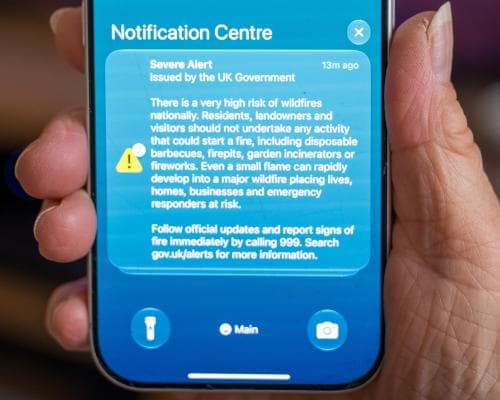
At 7pm on Friday, Thérèse Coffey—a former Conservative cabinet minister—was nine miles from a nuclear power station when her phone let out a piercing, panic-inducing wail. It was a 'severe' emergency alert, the kind reserved for existential threats. The message? A generic warning about wildfires. Coffey, no stranger to policy nuance, was unimpressed. 'Was expecting [a] much more specific alert,' she posted on X. She wasn't alone. Thousands of Britons, from academics to broadcasters, were left shaking their heads at the alarm that buzzed across England and Wales—a moment that, for the wealth desk, reads less as a bureaucratic fumble and more as a flashing red light for capital allocation.
The alert was triggered by a record-breaking wildfire season. The number of blazes in England and Wales has already surpassed the 1,017 recorded in all of 2025—and we're not even through the summer. Fire services declared 11 major incidents in a single 24-hour period starting Thursday. Homes were destroyed, residents injured in the West Midlands, and Prime Minister Keir Starmer warned the nation is 'a tinderbox right now.' This isn't just a weather story. It's a balance-sheet story. For the ultra-wealthy, who increasingly park money in real estate, infrastructure, and insurance-linked securities, the cost of climate volatility is becoming a line item that demands attention.
Let's talk mechanics. The UK's emergency alert system, rolled out in 2023, was designed for 'drop everything' scenarios—nuclear attacks, catastrophic floods, terrorist threats. Instead, it fired a generic wildfire warning to millions, including those in urban centers like London, miles from any blaze. Academic John Ritzema called it a 'massive overreach,' arguing the system should be reserved for truly dire situations. Coffey echoed that, warning against 'Peter cries wolf' fatigue. The result? A public that's now more likely to ignore the next alert—just when the risk is escalating. For investors, this is a classic operational risk: a flawed communication channel for a systemic threat.
The financial angle is sharper than it appears. Wildfires are a known destroyer of value. In California, the 2018 Camp Fire wiped out $16.5 billion in insured losses. In the UK, the damage is smaller—but the trend is up. Insurers are already hiking premiums in fire-prone regions, and some are pulling coverage entirely. For wealthy landowners with estates in rural Wales or the Scottish Highlands, that means either absorbing higher costs or self-insuring. Meanwhile, the alert's timing—Friday evening, prime TV slot—sent a signal to markets: the government is scrambling. The One Show host Ronan Kemp was caught mid-broadcast, saying, 'We've got some form of fire alarm going on.' That's not the image of a prepared state.
There's a deeper play here for the smart money. Climate risk is becoming a pricing factor in everything from government bonds to property trusts. The UK's decarbonization efforts are lagging, and the alert inadvertently highlighted that. Chris Packham used the moment to plug a petition for a national climate briefing—a reminder that policy risk is rising. For billionaires and family offices, this is a twin threat: physical risk to assets and regulatory risk to portfolios. The wealthy are already moving capital into climate-resilient infrastructure, water rights, and renewable energy. The wildfire alert is a nudge to accelerate that shift.
What does this mean for the next quarter? Expect volatility in UK insurance stocks and a quiet uptick in demand for parametric insurance—policies that pay out automatically when a trigger like fire risk hits a threshold. Also watch for a bump in 'climate adaptation' funds, which are gaining traction among institutional investors. The alert's failure isn't just a PR blunder; it's a signal that the state's risk-management systems are outdated. For those who manage wealth, the lesson is clear: don't rely on government alerts to protect your assets. Build your own buffers.
The forward-looking take is simple. The UK's wildfire season is a preview of the new normal—and the alert system's misfire is a metaphor for the broader unpreparedness. For the wealthy, the smartest move is to treat climate risk as a permanent feature of portfolio construction, not a tail risk. That means diversifying into assets that thrive in a hotter world, hedging with catastrophe bonds, and scrutinizing every property purchase for fire exposure. The alarm may have been generic, but the message for capital is specific: adapt, or watch your wealth go up in smoke.