The 91-Year-Old Artist Who Turned Canvas Inside Out — and Built a Market
Ha Chong-Hyun's revolutionary 'back-pressure method' — pushing paint through hemp from behind — is entering its global prime, with a Lisson Gallery show and a first North American museum retrospective. The Dansaekhwa movement he helped define is now a blue-chip market force, proving that material innovation can outlast generations.
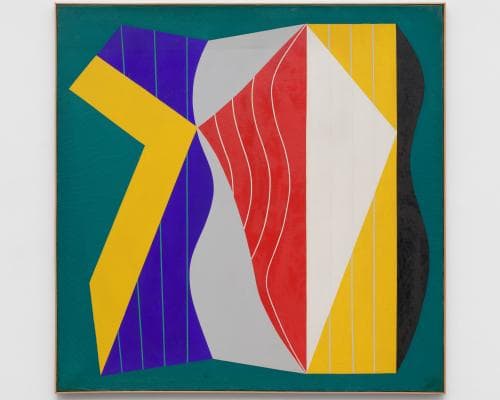
In the early 1970s, a Seoul-based artist had an idea so simple it bordered on heresy: what if paint didn't belong on the front of the canvas? Ha Chong-Hyun, then in his late thirties, flipped the logic of painting. He stretched rough hemp — a coarse, loosely woven fabric used for sacks and filtration — and pushed thick oil paint from the back, forcing it through the gaps in the weave. On the front, he manipulated the bulging pigment with handmade tools, creating ridges and troughs that mimic brushstrokes but are, in fact, something entirely new. He called the technique bae-ap-bub, or the 'back-pressure method.' He has used it for over five decades, titling every work 'Conjunction' — a nod to the meeting of artist and material — followed by a date. At 91, Ha is no longer just a painter. He is a living proof that one stubborn, tactile idea can outlast every trend and still command the attention of the world's most discerning collectors.
That attention is now peaking. In September, Lisson Gallery in London will open a selection of Ha's Conjunctions alongside his earlier experimental works, timed to precede his first-ever North American museum retrospective at the Asian Art Museum in San Francisco. Max Bossier, Lisson's director, puts it bluntly: 'The technique he developed was really revolutionary. It hadn't been done before.' That is not hyperbole. In Western art history, the canvas is a passive surface — a membrane to be painted on. Ha treated it as an active participant, a sieve that shapes the paint as much as the artist does. The result is a body of work that feels both ancient and futuristic: raw, mineral, and strangely alive, as if the pigment is breathing through the cloth.
Ha's breakthrough did not happen in a vacuum. He emerged from a generation of Korean artists who, in the 1970s, rejected both the academic realism of their elders and the imported abstraction of the West. They stripped painting down to its bones: color, material, and process. This loose movement, retrospectively named Dansaekhwa (literally 'monochrome painting'), included Lee Ufan and Park Seo-Bo, each with their own signature method — Ufan's repetitive brushstrokes, Park's scored and pressed surfaces. But Ha's back-pressure method stands out for its sheer physical audacity. He does not paint the surface; he penetrates it. That act of pushing paint through a woven barrier carries a quiet political resonance, too — a metaphor for persistence in a country that, during his formative years, was under authoritarian rule and still rebuilding from war.
The market has caught up. For decades, Dansaekhwa was a domestic phenomenon, known mainly to Korean collectors and a small circle of curators. Over the past ten years, that has changed dramatically. Auction prices for Ha's Conjunctions have climbed into the millions of dollars, with his work appearing in major museum shows from New York to Paris. Lisson, which represents Ha globally, has seen demand surge from Asian and Western buyers alike. The San Francisco retrospective — curated by the Asian Art Museum's Abby Chen — will be a litmus test for how far the movement can travel beyond its home turf. If the reception mirrors recent Dansaekhwa exhibitions in Europe and the US, Ha's star will only rise further.
What makes this moment particularly interesting is the generational shift. Ha is 91; Lee Ufan is 87; Park Seo-Bo is 92. The movement's founding figures are aging out, and their estates are becoming a finite resource. That scarcity is a powerful driver for collectors who see Dansaekhwa as the last great untapped vein of postwar Asian art. But it also raises a question: can the movement survive its founders? Younger Korean artists like Kim Yong-Ik and Lee Bul have cited Dansaekhwa as a touchstone, but they have moved in very different directions. The market may be betting on nostalgia, but the art itself — rooted in process and material — offers a more durable lesson: that innovation is not always about novelty, but about commitment to a single, profound gesture.
For the deep-tech and billionaire set, Ha's story is a reminder that the most disruptive ideas often come from the least expected places — a coarse cloth, a tube of oil paint, and a stubborn refusal to accept the given order. As the world races toward AI and synthetic biology, there is something almost radical in Ha's patient, manual repetition. He has spent 50 years pushing paint through hemp, and the result is not monotony but a deep, evolving conversation between intention and accident. That is a kind of intelligence that no algorithm can replicate. And as his work enters the global spotlight, it may just inspire a new generation of creators — not in painting, but in any field where material and idea collide. The next time you see a canvas, remember: the revolution might be on the other side.