The £150 Million Whistle: Why the Premier League's VAR Crisis Is a Crisis of Authority
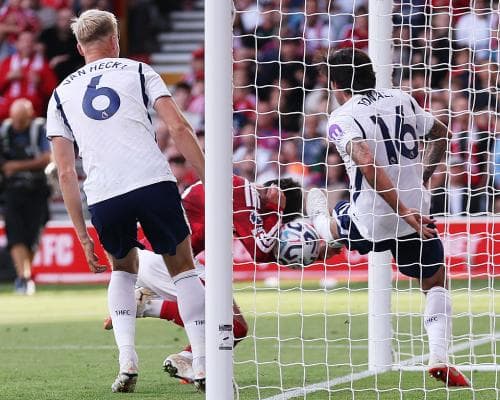
There are moments in sport that feel less like a game and more like a boardroom showdown—where a single, opaque decision can shift fortunes worth hundreds of millions. Saturday at the City Ground was one of those moments. Nottingham Forest's Neco Williams, fresh off signing a four-year contract, thought he had scored the winner against Tottenham. The crowd roared. The bench erupted. Then the video assistant referee, Peter Bankes, intervened, and the goal was wiped away. Forest's coach, Oliver Glasner, didn't mince words: the VAR was 'guessing.' In the world of high-stakes football, guessing isn't just a mistake—it's a breach of contract.
The sequence itself was a blur of chaos and instinct. A deflected shot from Morgan Gibbs-White bobbled toward the net. Sandro Tonali lunged to clear. Williams, airborne, stooped to head the ball in. From one angle, his shirt ripples—maybe from the ball, maybe from Tonali's boot. Bankes decided it was a handball. Williams was adamant: 'I headed it in between my arms. If you pause it, it looks like it hit my arm, but it didn't.' Glasner, who had watched five or six angles, admitted you could 'guess' it touched the arm. But guessing, he argued, is not 'clear and obvious.' The threshold for VAR intervention was supposed to be sky-high. This wasn't a slam dunk; it was a maybe. And in the rarefied air of the Premier League, a maybe is worth millions.
Here's the rub: this wasn't just a bad call. It was a failure of nerve. The Premier League briefed managers before the season that VAR should only overturn referees when the evidence is irrefutable. The goal was to strengthen the on-field official's authority, not undermine it. Instead, Bankes and referee Craig Pawson delivered a decision that felt like a hedge—a compromise between what they saw and what they feared. Glasner put it perfectly: 'With these kinds of situations, you weaken the referees.' In a league where every point is a commodity, and every match is a global broadcast, indecision is a luxury no one can afford. The officials didn't just cost Forest a goal; they eroded the very credibility of the system.
For Tottenham, this was a reprieve, but not a triumph. They failed to score for the third consecutive league match. No shots on target. Dominic Solanke's 88th-minute header onto the roof of the net was their most dangerous moment. Mykhailo Mudryk, returning after 645 days out due to a doping suspension, couldn't spark a fire. Spurs' season so far reads like a cautionary tale: five goals conceded, none scored in the league, save for a Carabao Cup romp against a Charlton B team. This isn't just a slump; it's a crisis of confidence. And while Forest walked away with a point, they left with a sense of injustice that money can't soothe. For the ultra-wealthy owners and executives watching from their skyboxes, this was a reminder that in the beautiful game, the most valuable asset isn't a striker's instinct—it's the authority of the whistle.
What does this signal about the state of football's luxury market? It's no longer enough to have the best players, the slickest kits, or the most exclusive hospitality suites. The product itself must be trustworthy. When VAR becomes a source of controversy rather than clarity, the entire spectacle loses its luster. For the discerning fan—the one who pays £10,000 for a season ticket or flies in for a match—ambiguity is a dealbreaker. They want certainty, decisiveness, and a sense that the game they love is being stewarded with the same rigor as their portfolios. Glasner's complaint isn't just about one match; it's about the erosion of confidence in the institution. And when institutions falter, the elite notice.
Looking ahead, the Premier League faces a choice. It can double down on technology, investing in semi-automated offside and ball-tracking chips that remove all doubt. Or it can embrace a more human touch, trusting referees to make calls and stand by them, with VAR reserved for only the most egregious errors. The former risks turning football into a sterile simulation; the latter risks more nights like this one. But one thing is certain: the status quo—where a VAR official 'guesses' and a goal is chalked off—is untenable. For the men and women who own these clubs, the math is simple. Every questionable decision is a hit to the brand. Every controversy is a dent in the global appeal. And in a sport where the margins are measured in milliseconds and millions, guessing is the one thing no one can afford.
For those who want to experience the beautiful game without the bureaucratic fog, the answer isn't to retreat to a screen. It's to embrace the live spectacle—the roar of the crowd, the tension of stoppage time, the unscripted drama that no algorithm can replicate. Because for all its flaws, football remains the ultimate luxury: a product that, at its best, is worth every penny. And on days like Saturday, it's also a reminder that the real prize isn't the trophy—it's the integrity of the contest.
The Experience
Secure your place in the directors' box for the next high-stakes Premier League clash, where every decision feels like a boardroom vote. Contact our concierge for access to the season's most exclusive fixtures.