Pakistan's Hospital Fire: The Hidden Cost of Failing Infrastructure
A fire at Pakistan's largest state hospital killed 14 newborns, exposing the lethal consequences of underfunded healthcare infrastructure. For wealth builders, this tragedy underscores the premium on investing in resilient systems and the market risks of neglecting critical public assets.
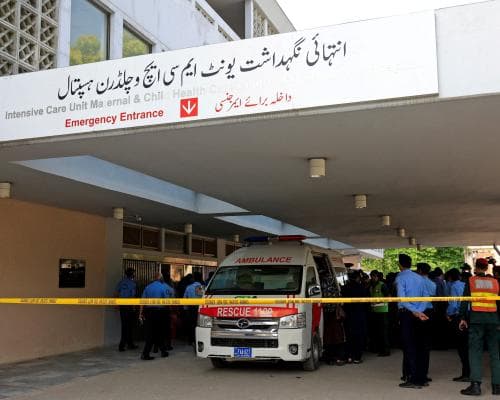
Fourteen newborn babies. Dead. Not from disease, not from complications of birth, but from a fire that tore through a maternity ward in the heart of Pakistan's capital. The blaze at the Pakistan Institute of Medical Sciences (PIMS) in Islamabad wasn't a random act of fate—it was a predictable outcome of a system stretched to its breaking point. For anyone who thinks infrastructure is a boring, back-office concern, think again. This is what happens when the machinery of public health collapses under the weight of neglect.
The fire broke out in the early hours of Wednesday, engulfing the ward where 15 babies were being cared for. By the time it was over, 14 were dead. One was saved by a doctor who risked his own life. The hospital's own statement confirmed the toll, and the health minister, Mustafa Kamal, pointed to a likely culprit: an air conditioner. But the real story isn't about a faulty appliance. It's about oxygen canisters that turned a small fire into a lethal inferno, incubators that became traps, and a maternity ward where new mothers had to flee down several flights of stairs, leaving their newborns behind.
Let's talk numbers, because this is a money-and-markets story at its core. Pakistan spends roughly 1.2% of its GDP on healthcare—one of the lowest ratios in South Asia. The result is a public hospital system that is chronically under-resourced, understaffed, and overburdened. PIMS is the largest state hospital in Islamabad, serving millions. It was already undergoing repair and construction work when the fire started, a detail that raises questions about oversight and safety protocols. The emergency call came in just before 7am, and rescue teams arrived quickly. But the damage was done. The fire was brought under control, but not before 14 families lost their children.
This tragedy isn't just a humanitarian catastrophe; it's a capital allocation failure. When governments underinvest in critical infrastructure, they're not just saving money—they're deferring risk. And that risk compounds. For the wealthy, this is a stark reminder of why they diversify across geographies and asset classes. It's also a warning about the hidden costs of emerging market exposure. You can't separate a country's economic growth from its ability to protect its most vulnerable citizens. When a hospital can't keep newborns safe, it signals systemic fragility that affects everything from sovereign bond yields to corporate earnings.
The market reaction has been muted so far—Pakistan's benchmark index barely moved on the news. But the political fallout is already brewing. Prime Minister Shehbaz Sharif has ordered an immediate investigation, promising 'the strictest action' against those responsible. President Asif Ali Zardari called the loss 'heartbreaking.' These are the right words, but words don't fix faulty wiring or replace outdated equipment. The real question is whether this tragedy will catalyze the kind of investment needed to prevent the next one. History suggests it won't. In 2012, a fire at a Karachi garment factory killed 289 workers, and little changed. In 2021, a fire at a COVID-19 ward in Nasiriyah, Iraq, killed dozens. The pattern is the same: outrage, promises, and then silence.
For investors, the lesson is clear. Infrastructure is not a luxury; it's a lifeline. Countries that treat it as an afterthought are building on sand. The wealthy already know this—that's why they park capital in private healthcare, in premium real estate with backup generators, in jurisdictions with robust building codes. But this tragedy should push even the most complacent to reassess. What does your portfolio say about your assumptions? Are you betting on systems that work, or hoping for the best in systems that don't?
Looking forward, this fire will likely become a political flashpoint in Pakistan's already volatile landscape. But for the global wealth community, it's a data point—a grim one—about the cost of neglect. The babies who died were not statistics; they were futures cut short. The families who lost them will carry this pain forever. And the rest of us? We should carry the lesson. Capital flows to safety. And safety, it turns out, is not just about high yields or low volatility. It's about whether the world you're investing in can keep its promises. This hospital failed to keep its most basic one. That's not just a tragedy. It's a market signal.