Nigeria's CWG pivots hard to hardware as software stalls
CWG's infrastructure unit revenue jumped 142% to N15.5bn in H1, reshaping Nigeria's oldest tech group—but margins lag the boom.
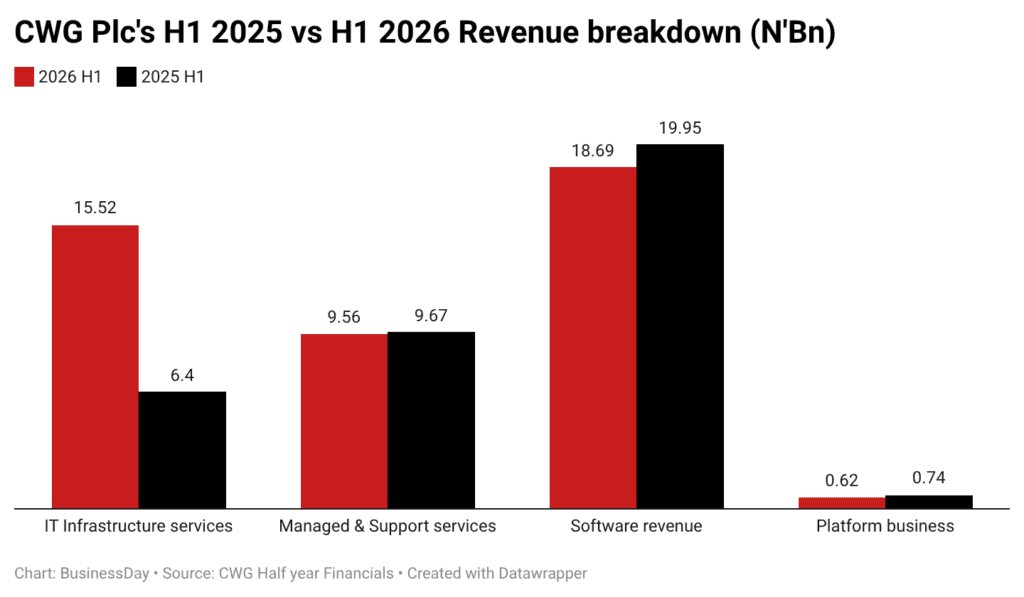
For decades, CWG Plc was the quiet giant of Nigerian corporate technology—the company that kept banks and government agencies running on software nobody ever saw. Now the numbers out of Lagos tell a different story, one that says the real money in African tech has moved from the code to the cabinet. In the first half of 2026, CWG's IT infrastructure arm—data centres, network gear, security kit, storage—hauled in N15.5 billion, a staggering 142.4 percent jump from N6.4 billion in the same period a year earlier. That single division accounted for the bulk of the group's N7.6 billion revenue increase, pushing total turnover to N44.4 billion, up 20.8 percent.
The shift is stark when you break down the mix. Infrastructure now contributes roughly 35 percent of CWG's group revenue, more than double its share of about 17 percent in H1 2025. Software, long the company's crown jewel and still its single largest revenue line, shrank 6.3 percent to N18.7 billion. Managed services held steady at N9.6 billion, while the platform business chipped in a modest N618 million. What this means for anyone tracking African digital economies: the continent's enterprise spending is swinging violently toward physical infrastructure—the servers, switches and security hardware that underpin cloud migration, fintech expansion and government digitisation—even as traditional software licensing stagnates. For an outsider, think of it as the difference between buying the engine and buying the car. CWG is now selling more engines, but the profit per engine is thinner.
Here's the rub, and it's the part that should make investors pause. Revenue is booming, but profit is barely breathing. Cost of sales jumped 24.2 percent to N35.3 billion, outpacing revenue growth, which squeezed gross margin down to 20.4 percent from 22.6 percent. Profit after tax inched up just 2.4 percent to N3.65 billion, and EBITDA rose a meagre 3.4 percent to N5.1 billion. Operating expenses climbed 13.6 percent on higher staff costs, commissions and directors' allowances. In plain terms, CWG is buying growth—stocking more inventory, taking on bigger projects, tying up cash in work-in-progress—but the bottom line isn't following. Inventories ballooned to N9.4 billion, prepayments shot up to N7.5 billion from N1.6 billion, and contract liabilities rose to N4.1 billion. The group is effectively financing its own expansion, and the market is waiting to see if that bet pays off in fatter margins or just fatter receivables.
Yet there's a genuinely bright spot buried in the ledger: cash. Net cash from operating activities exploded to N9.6 billion in H1 2026, versus a paltry N161.7 million a year ago. That improvement came largely from collecting on trade receivables and using N2.2 billion in withholding tax credit notes. For a Nigerian tech firm, where cash conversion is often the difference between survival and collapse amid currency volatility and high interest rates, this is no small achievement. It suggests CWG's management is getting disciplined about working capital even as it chases scale. The question is whether that discipline can be translated into better profitability on the infrastructure side, which currently operates on razor-thin margins compared to the software business it's displacing.
CWG's pivot is a microcosm of a broader African story. Across the continent, governments and corporations are spending heavily on digital backbone—undersea cables, data centres, fibre networks, security operations centres—often funded by international lenders and hyperscalers. Local tech companies that once sold licences are now being asked to build, install and maintain physical systems, a business that's capital-intensive and less elegant but far more tied to real economic activity. CWG's numbers suggest this transition is happening faster than most analysts expected, and that the winners will be those who can manage the logistics, inventory and cash-flow strain of being a hardware-heavy integrator in a market where payment delays are chronic. The company's next phase hinges on converting its 142 percent infrastructure surge into something closer to 20 percent profit growth. If it can, it becomes a template. If not, it becomes a cautionary tale about chasing revenue without guarding the margin. For now, the Lagos-based group is the best live experiment on how Nigerian tech companies adapt when the software era fades and the hardware era bites back.