Mourinho’s Madrid Return: A $1.5 Billion Bet on Chaos-Control
Real Madrid’s decision to rehire José Mourinho is a high-stakes managerial play from Florentino Pérez, aimed at dethroning Barcelona and restoring order to a club whose $1.5 billion squad imploded last season. For wealth builders, it’s a case study in how elite institutions value stability and brand power over long-term planning.
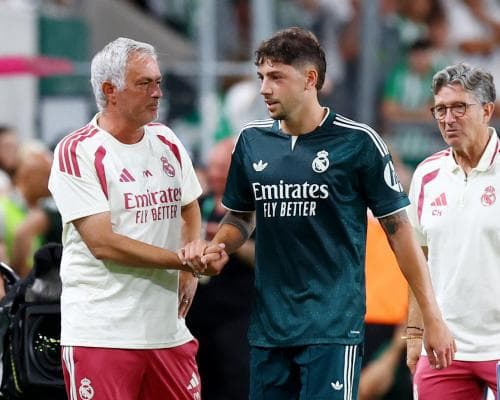
Florentino Pérez doesn't do nostalgia. The 79-year-old Real Madrid president is a construction magnate who once rebuilt the Santiago Bernabéu into a cash-printing machine, and he treats football like a leveraged buyout: buy the best assets, cut the noise, and deliver returns. So when he promised José Mourinho would return if he won June's snap election, it wasn't sentiment. It was a signal. Pérez is betting that the same manager who dragged Madrid to 100 points in 2012 can again impose order on a squad that last season dissolved into fistfights, hospital visits, and a trophyless campaign. The market for elite football managers is thin, and Mourinho is the ultimate distress-asset play.
Forget the romanticism. This is a capital-allocation story. Real Madrid's squad is valued at over €1.4 billion ($1.5 billion), yet they finished last season with nothing. Not La Liga. Not the Copa del Rey. Not the Champions League. The nadir came in May when Federico Valverde was taken to hospital for stitches after a training-ground bust-up with Aurélien Tchouaméni — a physical manifestation of a locker room that had become a hedge fund with no risk officer. By then, Madrid had already conceded the title to Barcelona in the clásico, and an online petition was circulating for the club's board to resign. When your $1.5 billion portfolio loses 20% in a quarter, you don't hire a philosopher. You hire a turnaround specialist.
Mourinho is that specialist, but the mechanics of his return are as political as they are tactical. Pérez had to override his own chief executive, José Ángel Sánchez, who last summer pushed hard for Xabi Alonso. Alonso's tenure lasted barely six months before he was sacked in January, replaced by interim boss Álvaro Arbeloa, who presided over the chaos. Pérez, sensing his legacy was slipping, made the Mourinho appointment a campaign promise. He announced it on the opening day of the World Cup — a power move designed to dominate global headlines. This is how the ultra-wealthy operate: they don't react to crises, they manufacture their own narratives.
The financial logic is brutal but sound. Mourinho's first spell at Madrid from 2010 to 2013 was a commercial and competitive triumph: a league title with a record 100 points, a Copa del Rey, and a Supercopa de España. His brand is polarizing, but polarizing sells. Madrid's commercial revenue has grown 40% since he left, yet the club still needs a winner to justify its $1.5 billion wage bill. Mourinho's contract is reportedly worth €20 million a year — a rounding error for a club that generates over €1 billion annually. The real cost is the risk of another implosion. But Pérez is 79. He doesn't have time for another failed experiment. He needs a manager who will squeeze every drop of value from the squad before he hands over the keys.
Jorge Valdano, who worked with Mourinho during his first tenure, warns that “almost 15 years have passed: football is no longer the same, society is not the same, Florentino is no longer the same, and Mourinho certainly won’t be either.” That's a polite way of saying the game has evolved. Modern managers are data scientists, not just disciplinarians. Mourinho's last few jobs — at Tottenham, Roma, and Fenerbahçe — ended in acrimony and underperformance. But Pérez is betting that Mourinho's tactical pragmatism, combined with a squad that includes Vinícius Júnior, Jude Bellingham, and Kylian Mbappé, is enough to outlast Barcelona's tiki-taka revival. It's a classic value-investing thesis: buy a beaten-down asset with a proven manager, hold for two years, and sell at the peak of the hype cycle.
For wealth builders, the lesson is simple: when a family office or a sovereign wealth fund backs a turnaround, they don't care about style points. They care about returns. Mourinho's return is a bet that order, discipline, and a ruthless focus on results will outperform Barcelona's more aesthetic approach. If it works, Madrid reclaims La Liga and the Champions League, and Pérez gets to crown his exit with a trophy. If it fails, the club's brand takes a hit, but the balance sheet won't collapse. This is the beauty of elite football economics: the downside is limited, the upside is infinite, and the narrative always sells tickets. Mourinho's second coming isn't a football story. It's a capital story with a $1.5 billion price tag.