Montecito's Royal Residue: The Real Estate Economics of Celebrity Gravity
As Prince Harry and Meghan Markle decamp from Montecito, the California enclave's luxury property market faces a subtle but telling recalibration. The town's real lesson isn't about royalty—it's about how billionaire capital and global celebrity transform micro-economies, and what happens when the spotlight moves on.
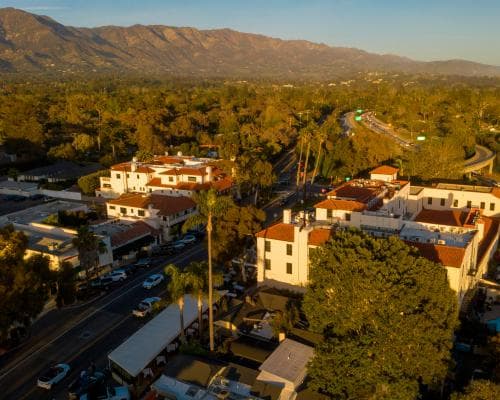
The helicopters have left. The paparazzi have filed their last long-lens shots. And on Coast Village Road, the lunch crowd is back to debating property lines rather than palace intrigue. Montecito, the bucolic billionaire playground north of Los Angeles, is saying goodbye to its most watched residents—Prince Harry and Meghan Markle—as they plot a return to the UK. But the real story isn't about a royal exit. It's about what happens to a town's economic gravity when the world's most famous couple stops being its center of mass.
For six years, Montecito was the backdrop for the Sussexes' post-palace experiment in privacy-as-product. Their $14.7m estate—purchased in 2020 after a very public split from Buckingham Palace—turned a quiet enclave of hedge funders and A-listers into a global media beat. News helicopters buzzed the eucalyptus groves. Journalists besieged a local Facebook page, only to be told by moderators: 'No one will sell out or talk to the press.' The town's tourism board leaned in, marketing 'Montecito: Fit for Royalty.' But the residents, by all accounts, treated the couple as just another set of neighbors—albeit ones with a security detail and a Netflix deal.
Now, as the couple eyes a UK comeback, the question isn't whether Montecito's property values will crater. They won't. Oprah, Gwyneth Paltrow, and Ellen DeGeneres still anchor the zip code, and the median home price hovers near $8m. The real shift is in the town's 'attention economy.' Celebrity residency isn't just about square footage; it's a form of place-based branding that attracts second-home buyers, wellness retreats, and venture capital looking for a serene HQ. When the Sussexes arrived, Montecito became shorthand for 'escape from the crown.' When they leave, that narrative loses its most compelling protagonist.
The technology here isn't silicon—it's status. And status, in the luxury real estate market, behaves like a high-frequency trading algorithm. A single headline can move sentiment, and a single departure can trigger a reassessment of 'premium' versus 'overheated.' Brokers in Santa Barbara are already whispering about 'the Sussex effect'—a temporary bump in inquiries from buyers who wanted to be near royalty, now recalibrating to a post-royal reality. That's not a crash; it's a correction. And for the deep-tech and billionaire set who own the neighboring estates, it's a reminder that even the most exclusive addresses are subject to the whims of narrative flow.
The broader signal? In the new gilded age, celebrity and capital are intertwined currencies. Montecito's experience mirrors what we've seen in Silicon Valley's 'billionaire bunkers' or Miami's crypto corridor: when a high-profile figure plants a flag, infrastructure follows—private schools, organic grocers, security firms, and yes, more billionaires. The exit of the Sussexes doesn't reverse that; it just resets the baseline. The town's real estate will continue to appreciate, but the 'royal premium'—the extra 5% buyers were willing to pay for a chance to wave at Meghan—will fade.
What's next for Montecito? Look for the next wave of 'quiet money' buyers: tech founders who want ocean views without the paparazzi, sovereign wealth funds eyeing turnkey estates, and perhaps a few crypto kings who see a dip as an entry point. The town's future isn't tied to any single celebrity; it's tied to its infrastructure as a sanctuary for the ultra-wealthy. That's a durable asset class, even if the headlines move on.
As the Sussexes pack their boxes, Montecito is learning a lesson that applies far beyond California: in the economy of attention, the exits are just as informative as the entrances. The town's next chapter won't be written by a royal decree, but by the quiet calculus of billionaires deciding where to park their capital—and their privacy. And that, in the end, is a story with no final page.