Miami's USTAAR accelerator turns student founders into Latin America's new bridge to US capital
How a University of Miami accelerator backed by a $5M gift is funneling Latin American founders into US markets.
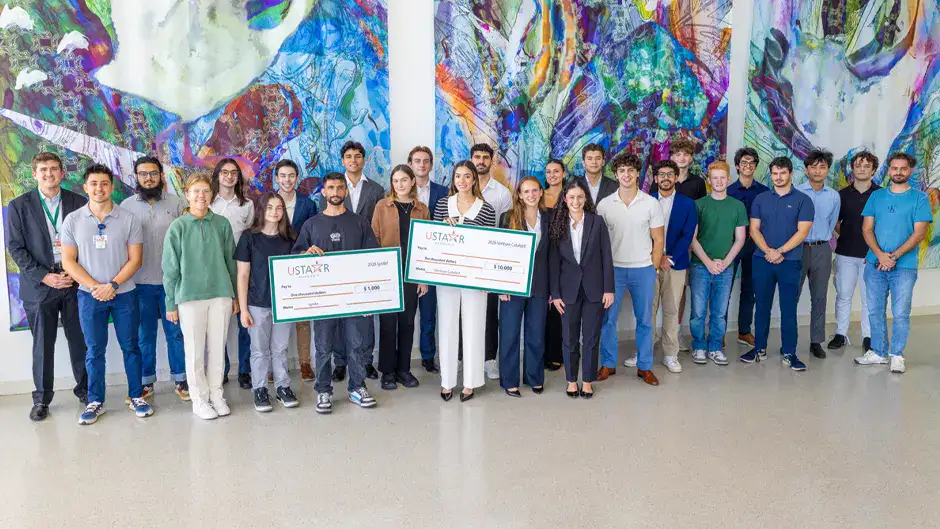
A Honduran lawyer building an app to connect people with licensed attorneys. An AI-run aquarium. A platform that scans moles for early melanoma. On paper, they have little in common — but all three passed through the same Miami doorway: USTAAR, the student accelerator run by the University of Miami. In a city that has spent a decade marketing itself as the hinge between the United States and Latin America, that doorway matters more than the palm trees suggest.
Latin America has long been the emerging market that never quite emerged — investment hovered near 20% of GDP from 1997 to 2022, trailing Poland and Turkey by a wide margin. For a founder in Bogotá or São Paulo, that gap means fewer checks, thinner mentorship and a brutal climb toward the world's biggest consumer market. Miami has positioned itself as the fix: this year it cracked the top 20 global startup ecosystems, with companies based there now carrying an estimated enterprise value above $670 billion, much of it fueled by access to Latin America and, increasingly, Spain.
USTAAR is the practical expression of that promise. Launched in 2024 with a $5 million donation from Ángel Álvarez — a University of Miami alumnus who founded ABB Optical, one of the largest optical distributors in the US — alongside his brother Víctor, a retired White & Case partner, the program runs in two stages. First, founders get up to $10,000 in non-dilutive cash to validate an idea and build a minimum viable product. If traction follows, they can tap up to $100,000 in equity investment. Since its start, USTAAR has made 14 equity investments and, in April, handed $100,000 checks to five startups at its third annual pitch competition — among them Aura Insights, Suisqua, SkinSmart, Textile and AIdMD.
The program's director, Suhrud Rajguru, is himself a founder, which shapes the pitch. "As a founder myself, I have gone through many of the difficulties these startups face," he told the university's student newspaper. "That's why we built a program that offers hands-on mentorship, community partnerships, networking opportunities, and seed capital." For students who arrive from Honduras, Colombia or Brazil, that mix is often the first taste of how US capital actually behaves — patient, structured and demanding proof.
Reynaldo Pineda embodies the regional flow. A Honduran lawyer and doctoral candidate at the University of Miami School of Law, he founded ULaw, an app that connects users with licensed attorneys for specific queries. The startup is now in the USTAAR portfolio, trying to crack the US legal market. Last year, Pineda spoke to Honduran legal professionals about that challenge, hammering a lesson almost every immigrant founder learns the hard way: you must build connections from scratch, reinvent yourself in an unfamiliar ecosystem, and accept that local rules do not travel. His path is not unique — more founders from the region are landing at Miami universities precisely for that foot in the door.
What USTAAR signals about South American wealth is subtle but real. The region's capital problem was never just a shortage of money — it was a shortage of bridges. Miami's accelerators, from USTAAR to StartUP FIU and Miami Dade College's Build Up, are becoming those bridges, offering validation that can unlock US customers and later, US venture dollars. The $5 million gift from the Álvarez brothers, both children of Cuban immigrants, is a bet that the next generation of Latin American founders will not need to choose between home and opportunity — they can build from Miami and scale everywhere.
The question is whether that bridge becomes a one-way street or a rotating door. If USTAAR and its peers keep sending capital and mentorship south while pulling talent north, Miami could finally deliver on its oldest promise. For a Honduran lawyer with an app, that promise is not abstract — it is the difference between a pitch deck and a company.