Canada's Trade Walkout Signals a New Era of Economic Sovereignty
Mark Carney's refusal to accept a US trade deal that weakens French language protections marks a pivotal shift in Canada-US relations, signaling a move toward economic sovereignty over traditional alliance. This decision could redefine North American trade dynamics and set a precedent for cultural protections in trade agreements.
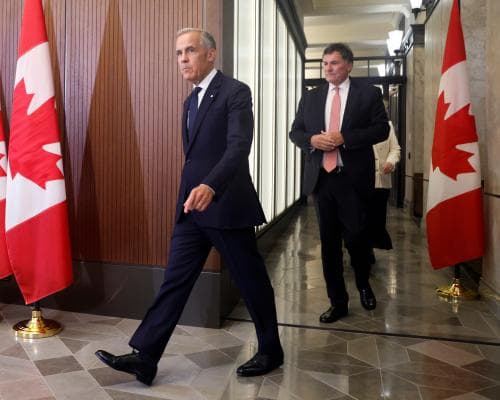
In a shipyard in Quebec, amid the clang of steel and the salt of the St. Lawrence, Mark Carney delivered a message that will echo far beyond the province's borders: some things are not for sale. The Canadian prime minister's words—'in Quebec, these are rights'—were a quiet but definitive rebuke to American negotiators who saw French language protections as mere 'irritants' in trade talks. It was a moment that crystallized a new reality: the era of frictionless, good-faith trade between Canada and the US is over, replaced by a hardened calculus where cultural sovereignty and economic leverage are inseparable.
Carney's decision to walk away from the negotiating table last week was not a tactical maneuver. It was a declaration. The collapse of talks, followed by US tariffs on roughly 5% of Canadian exports, has pushed the two nations into what many Canadian political leaders now openly call an economic war. But Carney's framing is more sophisticated—he is not just fighting tariffs; he is defending the very architecture of Canadian identity. The proposed deal, which would have weakened French language protections, was a bridge too far. For Carney, a former central banker who has navigated global crises, this is about the long game: building a resilient economy that does not bend to the whims of a mercurial neighbor.
The technology and capital angle here is subtle but profound. While this story is not about silicon chips or AI models, it is about the infrastructure of economic power. Carney's refusal to concede on language rights is a signal to global investors that Canada's market comes with non-negotiable conditions—conditions that protect its cultural fabric. This is a bet on 'sovereign resilience' as a form of competitive advantage. In a world where supply chains are being re-engineered and nations are hoarding strategic assets, Canada is positioning itself as a partner that demands respect, not just access. The shipyard visit with Quebec's premier was a visual metaphor: Canada will build its own future, literally and figuratively.
The market context is fraught. Trump's social media posts, threatening new tariffs on cars and trucks, are not just bluster—they are the opening salvo in a broader campaign to reorder North American trade. Canada's retaliation, set for early September, will target a carefully selected basket of US goods. But the deeper signal is for multinational corporations: the days of treating Canada as a docile, resource-rich appendage to the US economy are over. Companies that want to do business here will need to navigate a more assertive, culturally conscious government. This is a shift that could ripple through industries from automotive to agriculture, as Canada recalibrates its trade relationships toward Europe, Asia, and beyond.
For the innovation sector, this standoff is a wake-up call. Canada has long been a quiet powerhouse in AI, with Toronto and Montreal as global hubs. But its reliance on US markets for everything from software to hardware has been a vulnerability. Carney's hard line on trade could accelerate efforts to diversify export destinations and build domestic supply chains, particularly in critical technologies. The federal government's recent investments in AI infrastructure and clean tech are part of a broader strategy to reduce dependence on the US. This trade dispute may be the catalyst that pushes Canada to become a more self-reliant innovation economy, one that can compete on its own terms.
Looking ahead, the implications are stark. If Canada holds its ground, it could set a precedent for how smaller economies negotiate with superpowers—not just on tariffs, but on values. The French language is a proxy for a larger question: what is a nation willing to sacrifice for economic gain? Carney's answer is clear. He is betting that Canada's future lies not in appeasement, but in a confident, principled stance that will attract allies who share its values. The next few months will be a test of wills, but one thing is certain: the old playbook is gone. Canada is no longer just a trading partner; it is a sovereign power drawing its own lines in the sand.