How Crypto's 2026 Marketing Money Actually Moves — and Why Africa Should Watch
Crypto marketing budgets are shifting from KOL sprays to AI search optimization. New data shows where money works — and what African founders can learn.
For anyone tracking where Africa's newest fortunes are being built, the most important ledger in crypto right now isn't on any exchange — it's buried in the marketing budgets of mid-tier projects spending $20,000 to $100,000 a month. That's the money that decides which tokens break out, which founders get a second round, and which African teams get noticed by global liquidity. And according to fresh execution data from campaigns run across influencer activation, AI search optimization, and public relations, the old playbook is quietly dying.
The core finding is blunt: the biggest line item in most Web3 marketing budgets — 30 to 40 percent going to creator distribution — is also the most wasteful. Not because influencers are useless, but because most projects brief agencies on assumptions rather than evidence. The numbers that matter come from real campaigns, not surveys. Take the Banana Gun case: a Telegram-based trading bot facing a hard public deadline in a Bybit contest. Instead of a slow, staggered rollout that leaks signal into the noise, the campaign compressed 69 KOLs across five regions into a 72-hour window — 43 YouTube videos, 34 X posts, over 4.27 million tier-1 follower reach. The token moved from $15.63 to $43.12, a 176 percent jump, and held its uptrend for six weeks. That's not influencer magic; that's compression physics.
The reason this matters beyond crypto Twitter is that it reveals how capital now treats attention. In Africa, where retail adoption has been driven by peer-to-peer Telegram groups and WhatsApp channels, the lesson is direct: a synchronized push that registers as a real market signal beats a month of scattered posts. But there's a second, quieter shift with bigger implications for African founders. Token allocation — paying creators partly in project tokens — is now standard on roughly 90 percent of deals above $10,000. That means dilution is priced into every campaign before it starts. African startups that don't model that cost are giving away equity-like value without knowing it.
The more structural change, though, is the rise of Generative Engine Optimization, or GEO — structuring content so that ChatGPT, Perplexity, Gemini, and Google's AI Overviews cite you. Two years ago, almost no crypto budget had a line for it. In 2026, projects without it are ceding authority to competitors who show up in AI answers. The Godex case is the proof point: an anonymous crypto exchange with declining organic visibility and no room for paid ads in a restricted niche. By rebuilding discoverability through AI SEO and strategic PR — no paid ads — the project saw 12x growth in ChatGPT traffic, 6.2 million monthly AI audience reach, over 2,000 citations across large language models, a 24 percent conversion lift, and 726 percent growth in Bing organic traffic. The mechanism wasn't a single tactic; it was treating AI search as a unified authority system — intent-based content clusters, editorial placements generating real backlinks, and consistent brand signals across sources LLMs index heavily, from Reddit to GitHub to established crypto media.
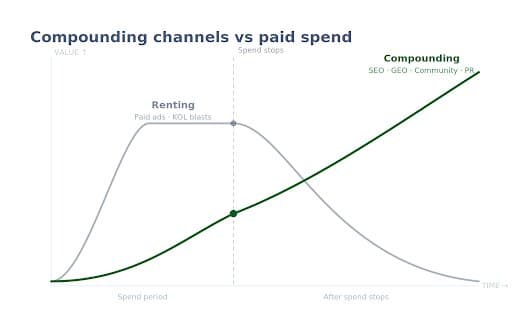
For an international reader watching African capital flows, this is the signal hidden in the noise. Traditional paid channels die the moment you stop paying. AI citations, editorial mentions, and content authority compound. In a niche where paid advertising is restricted — which describes much of Africa's regulatory landscape for crypto — this isn't a nice-to-have; it's the only scalable model. Market rates reflect the shift: generalist agencies charge $2,000 to $8,000 monthly for GEO and ChatGPT SEO, while specialists start at $5,000 to $8,000 and up. That's a real line item now, not an experiment.
The forward-looking read for African founders and investors is uncomfortable but clear. The era of spraying KOL budgets and hoping for lift is ending. The winners in the next cycle will be those who treat AI search visibility as infrastructure, not marketing — and who understand that in a compressed attention economy, the money that moves markets is the money spent on being cited, not being seen. Africa's crypto builders, already used to doing more with less, may find that constraint is now an advantage. The budgets are shifting; the question is who reads the ledger early enough.