Europe's Heat Wave Is Burning Up More Than Forests — It's Torching Insurance, Energy, and the Continent's Fiscal Calm
As nearly 500 arrests for suspected arson in France and wildfires across half a dozen European countries make clear, the continent's climate crisis is now a full-blown capital markets event. Wealth builders must price in surging insurance claims, energy volatility, and the growing cost of climate adaptation — or get burned.
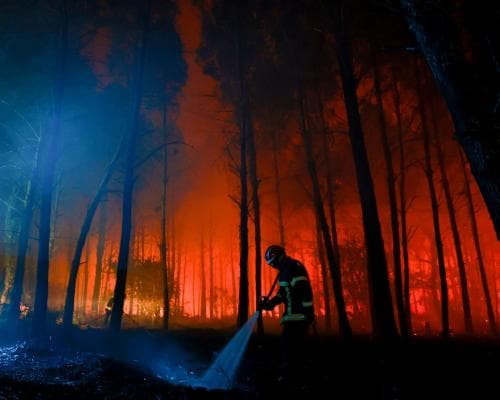
The smoke drifting over Europe this week isn't just a climate disaster — it's a balance-sheet event. Nearly 500 people have been arrested in France since July 1 on suspicion of starting wildfires, with French authorities saying about 70% of them are suspected of deliberate arson. That's not a weather report; that's a risk assessment. And for anyone managing serious money, the message is stark: Europe's heat wave is no longer a seasonal nuisance. It's a structural threat to insurance portfolios, energy grids, and the fiscal assumptions baked into sovereign bonds.
Start with the scale. A fire tore through a Croatian holiday resort on Friday, killing one person, injuring 40, and forcing 1,200 to evacuate. In France's Landes region, a new blaze ripped through nearly 1,100 hectares of tinder-dry pine forest in under 24 hours, forcing the evacuation of more than 525 people from the village of Luglon. In Belgium, the biggest fire on record is burning through the High Fens, the country's largest nature reserve. Greece is pulling stranded holidaymakers off beaches. Spain's army is rescuing historic relics. This isn't a localized event — it's a continental crisis stretching from the Atlantic to the Aegean.
Now, the numbers that matter to markets. The EU warns that 'very extreme' wildfire conditions stretch across the continent, and the human cost is staggering: three in five Europeans faced temperatures of at least 30°C on Friday, with about 150 million people enduring 35°C or more. But the financial cost is just beginning to crystallize. Insurers are staring down a wave of claims that will test the resilience of Europe's property and casualty market — already strained by years of climate-related losses. Reinsurers like Munich Re and Swiss Re are recalibrating their models, and expect premiums for fire-prone regions to spike. That's not speculation; that's how the cycle works. When losses cluster, capital gets repriced.
The arson angle adds a chilling layer. French authorities have detained 474 people, including 183 minors, since July 1. About 70% are suspected of deliberately starting fires; the rest did so accidentally. A 15-year-old boy was detained in connection with a fire near Bordeaux airport that killed two firefighters in July. For investors, this is a governance red flag. If a significant share of wildfires are human-caused, then prevention isn't just a public safety issue — it's a cost-control issue. Municipalities and utilities will need to spend billions on surveillance, firebreaks, and faster response systems. That's a capital expenditure that will hit local budgets, potentially crowding out other spending or pushing up borrowing.
And then there's the energy angle. Europe's heat wave is hammering power grids just as the continent scrambles to wean itself off Russian gas. Wildfires threaten transmission lines, and extreme heat reduces the efficiency of thermal power plants — from nuclear to coal. French nuclear giant EDF has already had to curtail output at some plants due to low river levels, and this week's fires near Bordeaux forced evacuations that disrupted logistics. The result: electricity prices are likely to stay volatile, and that volatility is a risk to every portfolio with exposure to European utilities, industrials, or consumer discretionary stocks. But it's also an opportunity — for those positioned in renewables, grid resilience, or climate adaptation tech, the crisis is a catalyst.
For the wealthy, the takeaway is blunt. This is not a 'one-off' event. The trend line is clear — wildfires, heat waves, and floods are becoming more frequent and more severe, and the costs are being socialized in ways that will hit tax bills, bond yields, and insurance premiums. The smartest capital is already moving: into climate-resilient infrastructure, into catastrophe bonds that hedge against exactly these risks, and into geographies that are less exposed to fire, flood, and drought. Europe's southern rim, once a playground for second homes, is now a liability — and smart money is quietly re-routing toward cooler climes and more robust supply chains.
What happens next? The immediate focus will be on the human toll and the firefighting effort. But for markets, the real story is the repricing of risk. Watch for insurers to raise rates in fire-prone areas — that's inevitable. Watch for utilities to pass on the cost of grid hardening to consumers — that's coming. And watch for governments to announce emergency spending packages to fund firefighting and recovery — that's already happening in France, where authorities are mobilizing 500 firefighters against the Landes blaze. For wealth builders, the play is to stay ahead of the curve: diversify away from climate-exposed assets, hedge with catastrophe bonds, and keep an eye on the companies that will profit from the rebuilding. The heat wave is a warning, but it's also a signal — and the smartest capital is already acting on it.