England's Onshore Wind Renaissance: A 10-Year High in Applications Signals a New Capital Cycle
A decade after the Conservative government's de facto ban, onshore wind applications in England have hit a 10-year high, with capacity entering the planning system more than tripling since Labour's 2024 policy shift. For wealth builders, this marks a definitive pivot in UK infrastructure capital flows, pointing to a multi-year cycle of renewable energy investment, land valuation shifts, and institutional-grade yield opportunities.
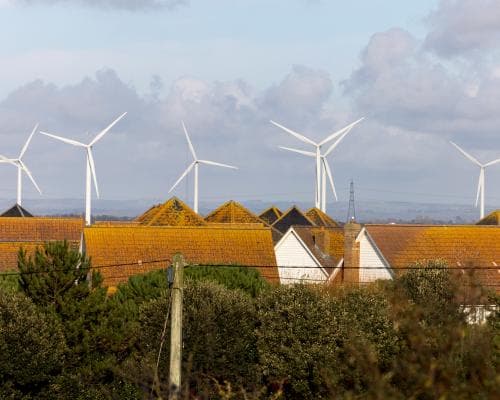
There's a quiet gold rush happening in the English countryside, and it's not for the faint of heart or the short-term trader. After a decade of regulatory frostbite, the onshore wind sector is thawing with a vengeance. New data reveals that applications for onshore windfarms in England have surged to a 10-year high, with roughly 45 new projects entering the planning pipeline in the year to March. This isn't just a policy footnote; it's a capital event. The machinery of British infrastructure investment is grinding back to life, and the smart money is already taking notice.
The scale of this resurgence is best measured in megawatts, the lifeblood of the energy trade. When Labour swept into power just over two years ago, they didn't just tweak the rules; they dynamited the de facto ban that had strangled the sector since 2015. The numbers tell the story of a dramatic velocity shift. Before the election, developers were submitting a paltry 9MW of onshore wind capacity per month in England, on a rolling annual average. By the start of this year, that figure had quadrupled to a stunning 36MW per month. To put that in stark relief, look back to the nadir of late 2023, when the monthly average had collapsed to a mere 1MW — a period so bleak that war-torn Ukraine was completing more onshore wind capacity than England. That comparison was a national embarrassment; today, it's a historical artifact.
The mechanics of this revival are as much about political will as they are about physics. The Conservative government, which imposed the ban, began to loosen the red tape in September 2023, but it was Labour's decisive action — lifting the blocks within days of taking office — that truly unlocked the floodgates. The government's strategy is three-pronged: abolish the restrictive planning rules, fast-track the largest onshore windfarm in England in a decade through its flagship renewables auction, and liberalize the micro-generation market. The latter is a particularly clever piece of capital democratization: farms and factories can now install a single small turbine, no bigger than an oak tree, without needing full planning permission. This isn't just about utility-scale projects; it's about creating a distributed asset base that can generate passive income for landowners and reduce operational costs for businesses.
For the wealth desk, the implications are profound. This is a classic infrastructure supply-chain story. The first wave of capital is already moving into land acquisition and planning approvals, which are the highest-risk, highest-reward stages of the development cycle. The second wave will hit the construction and turbine manufacturing sectors, where margins are fatter and the players are more established. But the most intriguing angle for the ultra-wealthy is the shift in land values. Agricultural land adjacent to grid connections or with high wind yield is now a premium asset class. We're seeing a bifurcation in the rural property market: prime wind-corridor land is commanding significant premiums, while off-grid parcels languish. This is a microcosm of the broader energy transition arbitrage — the gap between where capital currently sits and where it needs to be.
The signal here extends far beyond the English hedgerows. This is a clear indication that the UK is serious about re-industrializing its energy base. For institutional investors and family offices, the return of a stable, government-backed renewable pipeline in a G7 economy is a rare beacon. It offers the kind of long-duration, inflation-linked cash flows that pension funds crave. The government's rhetoric about strengthening energy security and getting bills down is politically astute, but the financial translation is simpler: this is a decade-long cycle of capital expenditure, with the first big contracts set to be awarded in the next 12 to 18 months. The developers who secured planning permission today are the ones who will be selling power to the grid at premium rates in 2028.
Looking forward, the critical metric to watch is the conversion rate — how many of these 45 applications actually get spades in the ground. The planning system, while reformed, is still a labyrinth. But the momentum is undeniable. The monthly capacity entering the system has tripled, and the pipeline is thickening. For the savvy investor, the play is not to chase the wind turbine stocks that have already rallied, but to look at the ancillary services: grid connection specialists, environmental impact assessors, and the legal firms handling the land rights. The next phase of this wealth creation won't be in the turbines themselves, but in the friction points of the bureaucracy. England's onshore wind revival is no longer a policy hope; it's a capital market reality, and the window to position ahead of the construction wave is closing fast.