Dangote's NGX portfolio swells by N1.47 trillion as cement rally outruns sugar slump
Dangote's listed NGX holdings rose N1.47tn in Q3 2026 to N16.54tn, powered by Dangote Cement's 10.8% rally even as NASCON slipped.
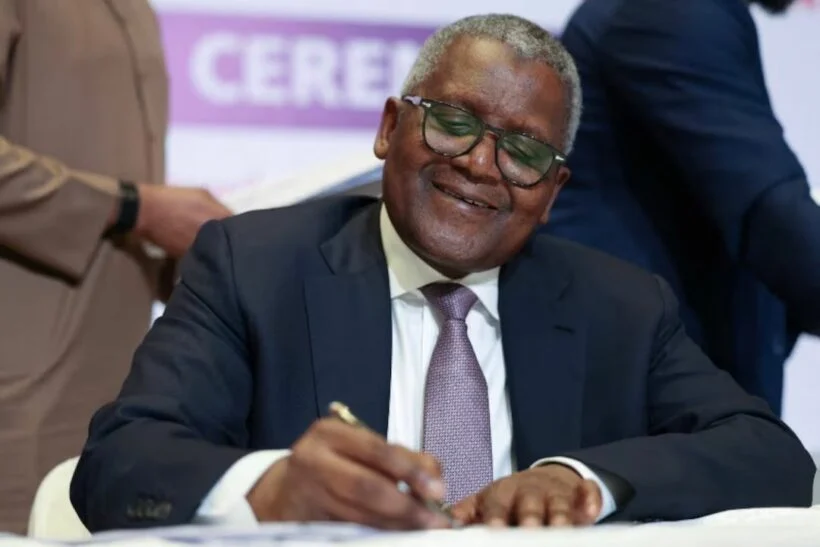
Aliko Dangote's Nigerian Exchange portfolio gained N1.47 trillion in the third quarter of 2026, a reminder that for Africa's richest man the bourse is now a second engine alongside the refinery that has re-rated his fortune. The jump lifted the combined market value of his direct and indirect stakes in Dangote Cement, Dangote Sugar Refinery and NASCON Allied Industries from N15.07 trillion at end-June to N16.54 trillion at end-September, according to Nairametrics' analysis of his holdings.
The quarter was carried almost entirely by cement. Dangote Cement's share price appreciated 10.8% between June 30 and September 30, pushing the value of his interest in the flagship from N14.11 trillion to N15.63 trillion — a gain of N1.52 trillion. That single line item more than accounts for the group total, because NASCON Allied Industries moved the other way: his stake in the salt and seasoning producer fell from N368.92 billion to N317.49 billion. Two of his three listed companies gained; the third did not. Dangote Sugar Refinery sat between those poles.
For readers outside Lagos, the architecture matters. Dangote Cement is not merely a listed company; it is the load-bearing wall of the Dangote group and the most liquid industrial name on the NGX, with plants spread across Africa and a pricing power that tracks Nigerian construction cycles, government infrastructure spend and the naira's fortunes. NASCON, by contrast, is a consumer-staples business exposed to input costs and household purchasing power — the kind of company that struggles when inflation erodes discretionary spending. The divergence in a single quarter tells you where Nigerian capital currently wants to be: hard assets and industrial scale, not pantry goods.
The timing is notable. Dangote is simultaneously expanding the empire, most visibly through the public offering of Dangote Petroleum Refinery and Petrochemicals, a 650,000 barrel-per-day plant targeting an eventual 1.4 million bpd. The refinery's start-up in 2024 is the single biggest reason his personal fortune has re-rated so violently: Forbes put him at $13.4 billion in 2024, $23.9 billion in its 2025 ranking, and $28.5 billion in its March 2026 annual list. An IPO of that asset would give outside investors their first direct claim on the cash flows that have driven the headline number — and would test whether Lagos can absorb a listing of genuine continental scale.
What does the quarter signal about African wealth more broadly? First, that the NGX has become a meaningful store of value for the continent's ultra-rich again, after years in which currency risk and capital controls pushed Nigerian money offshore. Second, that concentration is the defining feature of African billionaire balance sheets: one man's quarterly gain of N1.47 trillion rests overwhelmingly on a single cement stock. Third, that the refinery-to-IPO pipeline is the template — build hard infrastructure, list it, and let public markets mark your wealth. Tony Elumelu's parallel gains from Seplat and UBA in the same quarter suggest this is a pattern, not a one-off.
The next test is whether the cement rally holds through Nigeria's construction season and whether the refinery offering prices at a level that vindicates the Forbes trajectory. If it does, Dangote's listed portfolio becomes a bellwether for how global capital prices Nigerian industrial risk — and a template for the next generation of African founders deciding whether to stay private or ring the bell in Lagos.