Dangote Refinery's $19 Billion Bet Hits Nigeria's Stock Market — and Institutions Must Do the Math
Dangote Refinery's IPO brings a $19bn asset to Nigeria's exchange. Institutions weigh ₦65tn equity value against volatile refining margins.
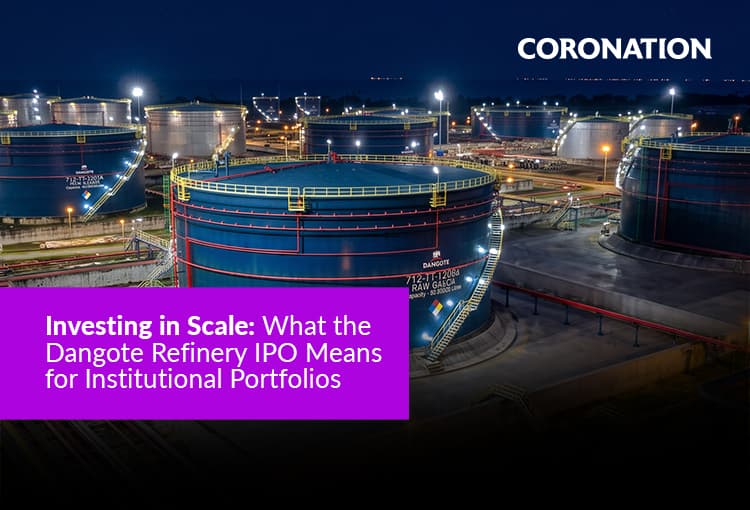
LAGOS — For anyone who tracks where serious African capital goes, the number that matters this week is not a valuation. It is 700,000. That is the nameplate processing capacity, in barrels per day, of the Dangote Petroleum Refinery and Petrochemicals FZE — an asset now being offered to the Nigerian public in a share sale that will test whether the country's equity market can absorb one of its most consequential industrial assets.
The offer, made under an SEC-approved prospectus dated 7 September 2026, brings the refinery to market at ₦525 per share. After the base offer, roughly 124.2 billion shares would be in issue, implying an indicative post-offer equity value of about ₦65.2 trillion. The prospectus reports revenue of ₦19.15 trillion and profit after tax of ₦2.504 trillion for the six months ended 30 June 2026 — a sharp reversal from a loss after tax of ₦723.1 billion in the 2025 financial year. In dollar terms, that half-year profit was US$1.821 billion. A simple annualisation of those six months suggests a price-to-earnings multiple of roughly 13 times. The prospectus itself is careful to call that a reference point, not a forecast.
The refinery sits inside the Dangote Industries Free Zone in Lagos, and the numbers attached to it are not modest. The prospectus puts the capital investment at approximately US$19 billion. Capacity has already been rerated upward from 650,000 barrels per day to 700,000 following debottlenecking and operational optimisation. The Issuer now targets approximately 1.4 million barrels per day by 2029 through a second crude distillation unit and associated processing units, with the broader expansion programme completing by 2030 — subject, the document notes, to regulatory approvals, financing availability and timely execution. For those outside Nigeria, the Dangote name is shorthand for Aliko Dangote's industrial empire, and this refinery is its most ambitious piece: a bet that Africa's largest oil producer can refine its own crude at home rather than export it and import finished products.
The institutional question is not whether the asset matters. It plainly does. At this scale, the refinery touches energy, manufacturing, logistics, trade and foreign exchange flows. It can shape the availability of refined petroleum products and Nigeria's position in regional and international product markets. But strategic importance and equity value are not the same thing. The prospectus shows a business still ramping up, and refinery earnings can swing hard with throughput, plant availability, crude sourcing and pricing, product yields, regional demand, freight differentials, refining margins, financing costs and exchange rates. One half-year of strong profit is evidence of potential, not a steady-state base.
Investors weighing the offer must therefore look past the headline profit. They need to test whether H1 2026 earnings are representative, how much debt and other claims sit ahead of equity, how the expansion will be funded, and what returns the additional capacity is expected to generate. The equity value should be stress-tested under different assumptions for utilisation, margins, crude costs, exchange rates, interest expense, maintenance shutdowns and capital expenditure. Coronation Merchant Bank is a Joint Issuing House to the Offer, Coronation Securities is a Joint Stockbroker, Coronation Registrars is the Registrar, and the Coronation Wealth platform provides access to an approved subscription channel — relationships that make the prospectus, not any commentary, the primary source of information.
What this deal signals is bigger than one company. Nigeria has spent years trying to deepen its equity market beyond banks and consumer names. A refinery of this scale, if it lists and trades with liquidity, would give institutional portfolios a new kind of exposure: an industrial asset tied to commodity cycles and currency risk, but also to domestic energy security. The expansion targets — 1.4 million barrels per day by 2029, full programme by 2030 — are ambitious and conditional. Whether they are met will depend on execution, financing and policy stability. For now, the offer asks investors to price a half-year of strong earnings against a decade of capital intensity. That is the calculation that will define whether this listing becomes a template for African industrial finance, or a cautionary tale about scale without steady returns.