Bessent's 'Economic Asphyxiation': The Sanctions Onslaught That's About to Redraw Global Capital Flows
Treasury Secretary Scott Bessent has unveiled a sweeping new sanctions regime targeting Iran's digital assets, gold, and shipping, signaling a decisive shift in US financial statecraft. For global investors and wealth managers, this is a warning shot: the era of quiet dollar-based hedging is over, and any entity touching Iranian commerce is now in the crosshairs.
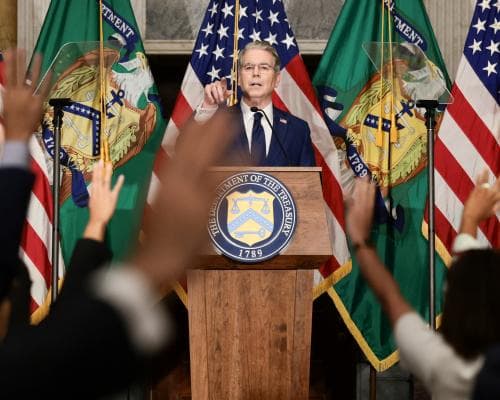
Scott Bessent didn't just announce sanctions on Iran on Tuesday—he declared war on the shadow economy that keeps the regime breathing. In a press conference that had the feel of a battlefield briefing, the Treasury Secretary promised an 'onslaught' of measures targeting five of Iran's 'most vital lifelines': digital assets, technology, gold, aviation, and shipping. But the real bombshell wasn't the list. It was the warning to the rest of the world: 'We know who they are, they know who they are, so when the hammer of US Treasury actions falls upon them they will have no one to blame but themselves.'
This is not your father's sanctions package. Bessent is going after the plumbing of global finance—the digital wallets, the bullion traders, the shipping flags of convenience—that have allowed Iran to monetize its oil and procure nuclear tech despite decades of US pressure. The scale is staggering: over 60 entities, individuals, and vessels are being hit in the first wave alone, and the Treasury's Office of Foreign Assets Control (OFAC) is clearly just warming up. Bessent's language was deliberately brutal—'economic asphyxiation'—and he made it clear that this is a campaign, not a one-off action.
Here's where it gets interesting for anyone with serious money in motion. Bessent explicitly refused to name which countries will face secondary sanctions—the penalties levied on third-party nations that continue to trade with Iran. When pressed on China, the largest buyer of Iranian crude, he deflected with talk of 'quiet diplomacy.' But the subtext was unmistakable: Beijing is in the crosshairs, and so is any multinational that has quietly kept the Iranian trade alive. Bessent's 'cure period'—a grace window to let businesses exit Iran-related deals—is a courtesy, not a reprieve. 'We do not have infinite patience here,' he warned, and the markets should take that at face value.
For the wealth desk, the immediate implications are electric. Gold, which has been on a historic rally, just got a new tailwind: if sanctions make it harder for Iran to move dollars or digital assets, bullion becomes the last clean store of value for sanctioned actors—and a more volatile one for everyone else. Shipping stocks, already sensitive to geopolitical risk, could see freight rates spike as vessels avoid Iranian routes. And digital assets? Bessent's inclusion of crypto in the sanctions mix is a major signal: the US is no longer treating Bitcoin as a harmless sideshow—it's a potential sanctions-evasion tool, and it will be policed accordingly.
The real story, though, is what this says about the US dollar's role as the ultimate weapon in economic statecraft. Bessent, a former hedge fund manager who knows exactly how capital flows, is using the dollar's dominance not just to punish Iran but to remind every sovereign wealth fund and family office on earth: if you want to play in the global financial system, you play by our rules. This is a power move that transcends Iran—it's a warning to any nation or entity that thinks it can quietly diversify away from dollar-based clearing. The phrase 'no one is above sanctions' wasn't aimed at Tehran; it was aimed at the world.
So what does a savvy investor do with this? The short answer: stay liquid, stay clean, and watch the secondary sanctions list like a hawk. If you have any exposure to entities that do business in the Gulf or with Chinese state-linked firms, now is the time to stress-test those positions. Bessent's 'cure period' is a window—but it's closing fast. The smart money is already repositioning: gold is up, shipping insurance is getting pricier, and the digital asset market is bracing for a regulatory hammer. This isn't a storm on the horizon. It's here, and the Treasury Secretary just told us he's not blinking.