Airbound's $37M bet: Can Indian drones make sky cheaper than road?
Airbound raises $37M led by Greenoaks to scale drone delivery, cut costs below trucking, and build larger aircraft.
For anyone tracking where African capital and logistics might head next, the news out of Bengaluru this week deserves more than a glance. A drone startup called Airbound has just pulled in $37 million in a Series A round led by Greenoaks, with participation from DoorDash, Lachy Groom, Lightspeed, and Humba Ventures. That pushes its total funding to nearly $50 million since its founding in 2023. The pitch is audacious: build aircraft so efficient that moving goods by air costs less than moving them by road — and eventually, carry people too.
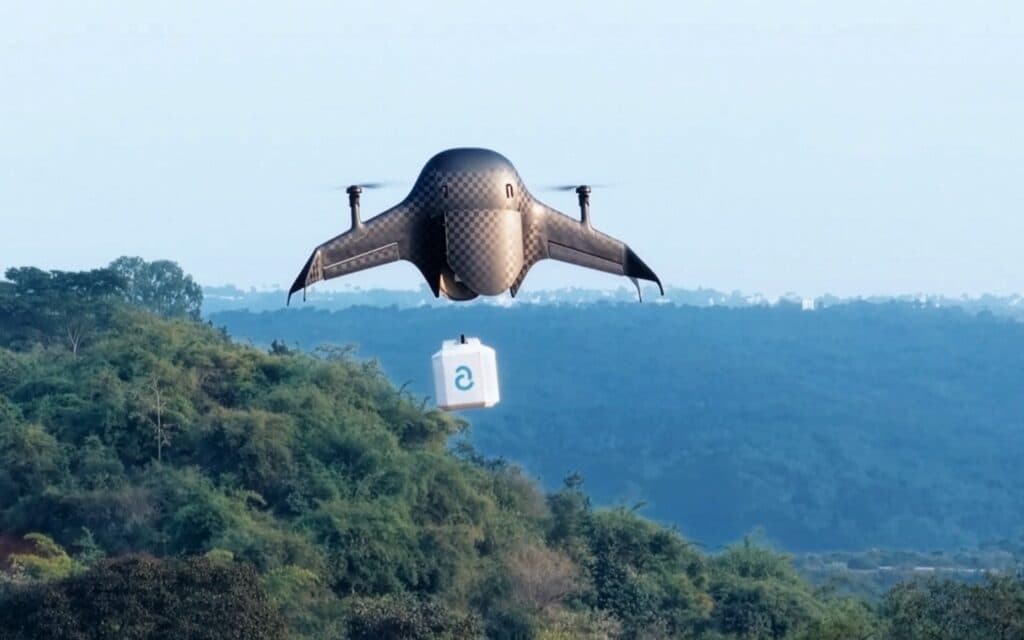
The core facts are straightforward. Airbound started by flying diagnostic samples for Narayana Health, a major Indian hospital chain, cutting delivery times from hours to minutes with no reported failures. Now it wants to pivot to commercial deliveries, talking to quick commerce and e-commerce players about shipping small packages by air. It has already signed a contract to build a drone delivery network across three cities in Andhra Pradesh, aiming for a scale of about 10,000 drone flights per day. The current drone, called TRT, weighs about 3.3 pounds and carries around 2.2 pounds. The next version will jump to 6.6 pounds with an 11-pound payload.
What makes this interesting beyond the headline numbers is the engineering bet. Most drones waste energy just keeping themselves aloft. Airbound uses a 'tail-sitter' design — the drone lifts off vertically like a rocket, then tips forward to fly like a fixed-wing plane. That gives it the flexibility of a quadcopter for takeoff and landing, plus the aerodynamic efficiency of an airplane in cruise. Founder Naman Pushp, who started building drones at age 15, frames it simply: 'Better physics leads to better economics, which unlocks the potential to move people and goods for a fraction of a cent.' Investor Neil Shah of Greenoaks echoes that, saying one autonomous aircraft could move a single package with the cost efficiency of a fully loaded 20-ton truck, meaning fast and cheap no longer have to be trade-offs.
For an international reader, the context matters. India's quick commerce market — think 10-minute grocery delivery — is a brutal testing ground for logistics innovation. If Airbound can make drone economics work there, where customers demand speed at rock-bottom prices, the model could be exported anywhere, including Africa. That's not lost on the investors. DoorDash joining the round signals that major delivery platforms see air freight as a serious alternative to congested roads. The barriers are real: regulation, drone manufacturing at scale, and airspace management. But the trajectory is clear — this isn't a science project anymore, it's a supply chain play.
What does this signal about capital and wealth in Africa? For one, the continent's logistics bottlenecks — poor roads, long distances, and fragmented last-mile networks — make it a natural candidate for drone leapfrogging. We've already seen medical drone deliveries in Rwanda and Ghana. Airbound's ambition to cut costs below trucking could change the calculus for African retailers, farmers, and health systems that currently rely on slow, expensive ground transport. The fact that a startup can raise $37 million for this vision shows that global venture capital is betting on air-based logistics as a scalable answer to infrastructure gaps, not just in India but across emerging markets.
The forward-looking picture is bold. Airbound is already working on larger aircraft that could eventually carry people. Pushp's vision is totalizing: 'We believe in a world where all movement happens in the air. Not some of it. Not most of it. All of it.' That's a long way off, and drone delivery still lags trucks in scale. But if the company can prove that air freight beats road freight on cost, the implications for how we move goods — and eventually people — are profound. For African entrepreneurs and policymakers watching from afar, the lesson isn't just about drones. It's about the willingness of capital to back hard engineering problems in emerging markets, and the possibility that the next leap in logistics won't come from Silicon Valley but from the streets of Bengaluru.