When the Green Belt Turns to Ash: Stourbridge and the New Calculus of Rural Living
The smoke was visible from the golf course first—a thin, grey smudge against a sky the colour of bleached bone. By late afternoon, it was a wall. Gemma Hobbs looked out her window on Osmaston Road and saw nothing but thick black smoke, the kind that swallows light and reason. Her partner Andy, 61, arrived home in a flap, shouting that they had to leave immediately. They grabbed what they could, which is never enough, and joined the exodus of neighbours who had, minutes earlier, been contemplating dinner. Nineteen homes in Stourbridge were fully destroyed that day; eighteen more were damaged. The fire, which leapt from the town's golf course into residential streets, moved with an exponential speed that Andy still struggles to articulate. "You don't expect something to be as exponential as this so quickly," he told reporters, standing in a makeshift evacuation centre at a local boarding school, clutching a plastic bag of belongings. The heat that day reached 38.1°C—a record for the UK, and the fifth consecutive heatwave. The air itself seemed to be holding its breath, then exhaling fire.
For those of us who chronicle the lives of the ultra-wealthy, the English countryside has long been the ultimate status symbol—a thatched-roof idyll, a weekend manor, a place to keep horses and raise children away from the noise of the city. Stourbridge, a market town in Dudley, is not quite the Cotswolds, but it shares the same fundamental promise: land, space, a connection to nature that money can buy. But this week, nature reminded us that it is not a amenity; it is a force. The fires that tore through the West Midlands were not an accident of dry grass and a dropped cigarette. They were the inevitable collision of a warming climate and a housing market that has pushed ever deeper into the green belt, into the wildland-urban interface—a term firefighters use for the zone where houses meet scrubland, and where the romance of rural living meets its pyrotechnic reality.
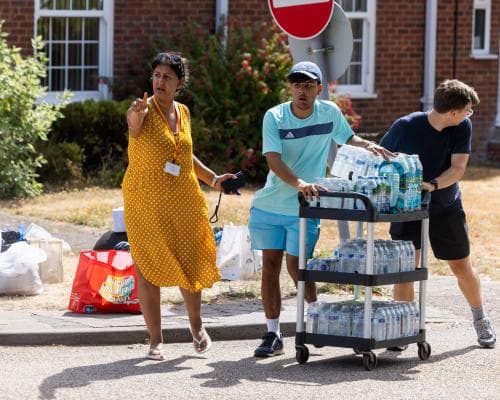
The response from the community, to their immense credit, has been nothing short of heroic. Neighbours helped neighbours evacuate, local authorities set up shelters within hours, and the fire service—stretched thin across eight simultaneous blazes—managed to prevent further loss of life. Fifty-four people were treated, nineteen hospitalised. Andy Burnham, the mayor of Greater Manchester, visited Stourbridge on Friday and called the UK a "tinderbox," announcing the commissioning of firefighting planes—a first for the country. "I've never seen scenes like this anywhere in Britain," he said, standing amid the charred skeletons of homes that had, days earlier, been filled with photographs, heirlooms, and the quiet accumulations of a lifetime.
For the collector of fine homes, this is a chilling moment of reckoning. The estate agents' brochures still promise "panoramic views over open countryside" and "private access to woodland walks." But the calculus has shifted. A property's value is no longer just about square footage or original fireplaces; it is about defensible space, fire-resistant materials, and the proximity of water sources. The ultra-wealthy have already begun to adapt—installing ember-resistant vents, replacing cedar shakes with metal roofs, and hiring landscape architects to create firebreaks that double as sculptural gardens. But Stourbridge is not a story of the super-rich; it is a story of ordinary people whose homes were their life's work, and who now sit in a hotel lobby, wondering what remains.
Gemma and Andy are among the lucky ones—they have insurance, a hotel room, and each other. But the psychological toll is profound. "It's just the fact you don't expect something to be as exponential as this so quickly," Andy repeated, as if saying it aloud might make it more comprehensible. The fires were over a mile from their home when they were told to evacuate, yet the smoke was already thick enough to blind. That is the new reality of living in the green belt: the fire does not need to be at your door to be at your throat. The question now is not whether Stourbridge will rebuild—it will, because communities like this do—but how. Will we rebuild the same way, with the same materials, in the same places? Or will we take this as a signal, as Burnham suggests, that the very notion of a "tinderbox" nation requires a fundamental rethink of where and how we build our homes?
As the sun set over the blackened hills, a strange quiet settled over Stourbridge. The golf course, once a symbol of leisure and order, was now a moonscape. The evacuation centre at the boarding school was emptying, as families found temporary lodging with relatives or in nearby hotels. The fire was contained, but the smoke of a larger question hung in the air. For the wealthy, the answer may be to buy a fireproof villa in Portugal or a penthouse in a high-rise with a sprinkler system. But for the people of Stourbridge, the answer is more complicated. They cannot simply move. They must adapt, or they must leave—and leaving the place you call home is its own kind of loss, one that no insurance policy can cover. The fires of July 2022 will be remembered as a turning point, not just for Stourbridge, but for every town on the edge of the wild. The green belt has always been a buffer between city and country; now it is a fuse. And the question, for all of us, is whether we are willing to live with the spark.