The Odd Couple: Mike Ashley’s Frasers Group Rescues Harvey Nichols
It was the kind of news that makes a certain sort of Mayfair lunch go quiet. Harvey Nichols, the fifth-floor temple of feather-trimmed cocktails and floor-sweeping couture, had called in the administrators. And who should step forward, cheque in hand, but Mike Ashley — the man who brought us Sports Direct, the retail equivalent of a bargain bin at a football stadium. The deal, confirmed on a grey Thursday morning, sees Frasers Group acquire the London, Edinburgh, Birmingham, Leeds, Bristol, and Manchester stores, with the Dublin outpost’s future still hanging in the balance. The price? A reported £40m — pocket change for a brand that once defined the very notion of aspirational shopping.
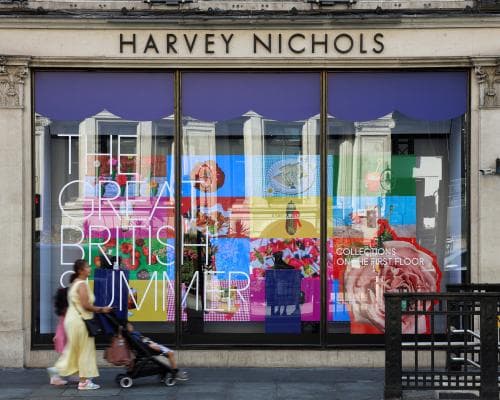
Let’s be clear about what was saved. Harvey Nichols is not just a shop; it’s a cultural landmark. Since 1831, it has been the place where London’s elite went to be seen buying things they didn’t need but absolutely had to have. The Knightsbridge flagship, with its famous fifth-floor restaurant and a window display that has launched a thousand Instagram careers, is the crown jewel. The brand’s international franchise outposts — Dubai, Riyadh, Doha, Kuwait, Hong Kong — will continue under the deal, their sheen intact. But the Oxo Tower restaurant, that riverside perch for power lunches with a view, is being sold off separately. A small mercy, perhaps, for those who prefer their champagne with a side of architectural heritage.
What does Ashley actually want with a luxury department store? The man who built an empire on discounted trainers and replica football shirts has been quietly amassing a portfolio of premium names — Flannels, the fashion-forward chain, being his most visible foray into the world of designer labels. Harvey Nichols, for all its faded glory, offers something Flannels never could: legacy. The store’s name alone carries a weight that no amount of neon signage can replicate. But make no mistake — this is not an act of charity. Frasers Group has already spoken of ‘significant restructuring and integration’ and a ‘review and rationalisation’ of the store portfolio. In plain English, expect fewer velvet ropes and more value rails. The question is whether the Harvey Nichols clientele will tolerate a store where the security guards might soon be wearing Sports Direct fleeces.
The market reaction has been, predictably, a study in mixed emotions. Luxury retail analysts have long argued that the sector is ripe for disruption, but this is disruption of a very particular kind. Ashley’s track record with House of Fraser — bought out of administration in 2018, with some 40 of its 60 stores since closed — does not inspire confidence in those who cherish the old-world charm of department stores. Yet there is a counter-argument: that Ashley is a survivor, and that his ability to squeeze value from distressed assets is exactly what Harvey Nichols needs in an era of online shopping and shifting consumer habits. The 1,200 employees will be watching closely, as will the landlords of prime high-street locations who have just seen their most glamorous tenant get a new, decidedly pragmatic landlord.
For the luxury consumer, this acquisition is a bellwether. It signals that the old guard — the aristocratic families, the quiet-money dynasties — are no longer the only players in the game. The new custodians of luxury are often self-made, brash, and unapologetically commercial. They understand that luxury is not just about heritage; it’s about footfall. They will keep the champagne on ice, but they’ll also be checking the margins on the canapés. The true test will come in the next twelve months: can Ashley’s team turn Harvey Nichols into a profitable enterprise without stripping it of the very essence that made it worth saving? Or will the Knightsbridge store become a strange hybrid — a place where you can buy a £5,000 handbag and a £12 football shirt under the same roof?
One thing is certain: the landscape of London luxury has shifted. Harvey Nichols will survive, but it will be a different beast — leaner, sharper, and perhaps a little less precious. For those of us who love the romance of a grand department store, there is a bittersweet comfort in knowing that it will still be there, its marble floors polished, its escalators humming. Whether the ghosts of its former glory will approve is another matter. But in the world of high-end retail, the show must go on — and if anyone knows how to put on a show, it’s the man who once sold us all a pair of trackies for a tenner.