The Championship's £100M Promotion Trade: Why Boro's Late Winner Moves Money
Middlesbrough's 90th-minute winner over Lincoln isn't just a football result—it's a financial signal in the £100M-plus promotion sweepstakes that drives English football's wealth engine. For investors and owners, every late goal shifts the odds on Premier League riches.
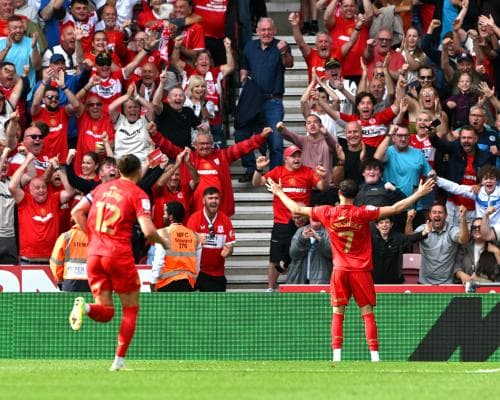
The 90th minute at the Riverside Stadium wasn't just about a back-flick and a roar. It was about the £100 million question. When Will Lankshear danced onto Riley McGree's byline cutback and steered the ball into the bottom corner, he didn't just win a football match—he moved money. Middlesbrough 2-1 Lincoln City. A late winner that, on the open market of promotion odds, quietly shifted the portfolio of every owner, hedge fund, and private equity group with skin in the English Championship game.
This is the wealth desk's favourite kind of story: a brutal, beautiful financial instrument disguised as a Saturday afternoon. The Championship is not merely a league. It is a £100 million-plus lottery ticket, where the difference between 2nd and 3rd place—between automatic promotion and the playoff lottery—is often worth more to a club's balance sheet than a decade of prudent trading. Lincoln City, returning to the second tier after a 65-year exile, played with the desperation of a startup burning cash. Middlesbrough, with the cool of a PE firm, found a way to close the deal.
Let's get to the mechanics, because the numbers here are the real protagonists. A single season in the Premier League is worth roughly £100 million in broadcast revenue alone—more than double what a Championship club sees from the EFL's collective deal. For a club like Middlesbrough, owned by Steve Gibson, a man who has poured over £150 million of his own fortune into the club since 1986, every point is collateral. The late winner doesn't just buy three points; it buys a marginally better shot at the golden ticket. The bookmakers' reaction was immediate: Boro's promotion odds shortened by a measurable margin after the full-time whistle, reflecting the market's view that their squad depth—Lankshear on the bench, McGree's inventiveness—is a serious asset.
The rarity angle here is Lincoln's. A 65-year wait for second-tier football is not a heritage play; it's a scarcity event. Their presence, and their narrow defeat, underscores the brutal financial gradient between the leagues. For the Imps, a club with a fraction of Boro's budget, the gap isn't just in skill—it's in the wage bill, the academy spend, and the ability to absorb a bad run. This season, their entire economic model is built on survival, not promotion. The data point that matters isn't a goal tally; it's the 4.85% yield on the Premier League's overseas broadcast rights, a figure that has been climbing steadily and makes the Championship's promotion chase one of the most undervalued assets in global sports.
What does this signal for the wealthy? Look at the broader pattern from Saturday's 3pm kick-offs. Four of six games ended in turnarounds. That's not just chaos; that's volatility. And volatility is where capital is made. The Championship is the world's most competitive football market precisely because the financial stakes are so punishingly high. Owners aren't just chasing glory; they're chasing the arbitrage between a £20 million wage bill and a £200 million windfall. The smart money is already positioning for the January transfer window, where a single £10 million striker can be the difference between a £100 million payday and another year in the wilderness.
For the wealth builders reading this, the lesson is simple: don't watch the scoreline, watch the balance sheet. Middlesbrough's late winner was a small but meaningful adjustment to the probability curve of promotion. Every goal, every injury, every loan move is a micro-adjustment to the odds. The same logic that drives a private equity deal—buy the asset, improve the operations, sell into a liquidity event—is playing out on the pitch every week. Lincoln's brave effort, and their 1-2 defeat, is a reminder that sometimes the best investment thesis is the one that's still building.
As the Championship table takes its early shape, the market is pricing in a long season. But the smartest capital is already moving. The Baggies held on at Norwich. Millwall's Josh Coburn looks like a two-goal revelation. And at the Riverside, a 20-year-old striker just made a claim for a starting spot that could be worth millions by May. The promotion race is a 46-game marathon, but the money is won and lost in moments like Lankshear's back-flick. It's not just football. It's the most liquid, most emotional, most unpredictable wealth transfer in sport. And it's only just begun.


