The Bear Market That Isn't: Why 7.3 Million People Are Watching Salmon-Fed Alaskan Bruins
Explore.org's Brooks Falls bearcam drew 7.3 million views this summer, up 70% year-over-year, as a record concentration of Alaskan brown bears turned a remote waterfall into the season's unlikely hit. For wealth builders, the surge underscores a booming 'nature-as-content' economy—one where passive wildlife streams are quietly becoming a high-engagement, low-cost asset class.
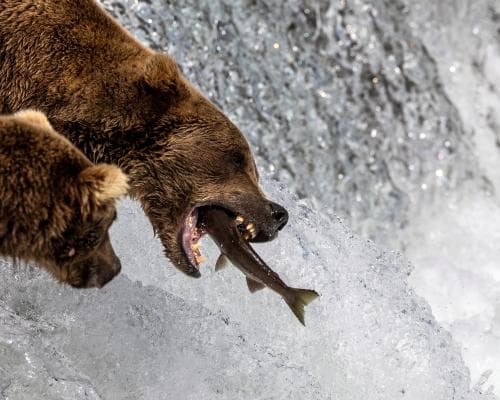
Forget Nvidia. The hottest ticket this summer wasn't a chip stock or a Fed pivot—it was a bunch of fat bears standing in a river, catching salmon with their mouths. The Brooks Falls bearcam at Katmai National Park pulled in 7.3 million views between June 22 and August 4, a 70% jump from the same stretch last year and more than double its 2024 numbers. That's not just a cute animal video. That's a media property outperforming most streaming platforms. And it's a reminder that the attention economy—the same one that moves billions in ad dollars and drives valuations for everything from Netflix to TikTok—has a wild new frontier: nature, unedited, unscripted, and utterly indifferent to your portfolio.
The numbers are staggering for a feed that's essentially a static shot of a waterfall. Explore.org, the wildlife network behind the cameras, has turned a remote corner of Alaska into a global appointment-viewing destination. More than a dozen bears at a time prowl the rocky shallows, chomping on sockeye salmon as they fight upstream. Candice Rusch, Explore.org's director of new media, attributes the spike to a simple ecological quirk: last year's massive salmon run spread the bears out across the river; this year's more moderate run forced them to congregate at the falls, creating a level of bear-on-bear drama that no scripted reality show could match. 'It's like the whole world discovered they could put bearcam on their TV at the same time,' Rusch said. 'Maybe people just have it on while they're cooking dinner.'
But don't mistake this for a passive wildlife feed. This is a sophisticated operation with real economic gravity. Explore.org, funded by the Annenberg Foundation, has been running these cameras since 2012, and the infrastructure is no joke: solar-powered transmitters, satellite uplinks, and a team that monitors the bears' safety and the stream's uptime like a day-trader watching the tape. The views translate into donations, merchandise, and—crucially—a massive database of behavioral data that scientists use to study everything from bear nutrition to climate impacts on salmon runs. For a foundation-backed nonprofit, that's an asset with compounding returns. For private investors, it's a case study in how 'passion content' can monetize at scale without a single ad break.
The bear market angle here is more than a pun. The surge in viewership mirrors a broader trend in wealth management: the wealthy are increasingly allocating capital to 'experience assets'—everything from safari lodges to conservation easements—that generate both financial returns and emotional dividends. The bearcam's success is a proxy for that shift. It's not just about watching animals; it's about the growing willingness to pay for proximity to nature, whether that's a $10,000-a-night eco-lodge or a $5 monthly donation to keep a camera running. Dr. Jeffrey Skibins, an associate professor at East Carolina University, notes that nature-based webcams improve conservation attitudes and behaviors. That's a soft-power metric, but it has hard-dollar implications: conservation-minded donors are more likely to write checks when they feel a personal connection to the subject.
So what does this mean for markets? The bearcam's 70% viewership jump is a leading indicator for the broader 'nature-tech' sector—think wildlife streaming, eco-tourism, and conservation finance. These are niches that often fly under the radar of institutional investors but are quietly becoming a favored allocation for family offices and impact funds. The data is compelling: engagement is up, costs are down (cameras are cheaper than ever), and the audience is global. If you're looking for a low-volatility asset with a built-in emotional hedge, a bearcam might not be a bad metaphor. It's stable, it's predictable, and it delivers returns in the form of pure, unadulterated awe.
But here's the forward-looking play: the bearcam's success is a warning shot to traditional media. If a bunch of bears can outdraw most cable news segments, what's the future of scripted content? The answer is that the bar for 'captivating' has shifted. Audiences are starving for authenticity, and nature delivers it in spades. For investors, that means the next big media winner might not be a studio—it could be a nonprofit with a solar panel and a good camera angle. The bears aren't going anywhere, and neither is the demand for their content. So the next time you see a 70% jump in a niche metric, don't dismiss it. That's the market telling you where the attention is flowing. And where attention goes, money follows—even if it's just a few dollars at a time, from a million people watching a bear eat a fish.
For now, the bearcam is a free, public good. But don't be surprised if, within a few years, some enterprising fund tries to package 'wildlife streaming rights' into a securitized product. The bears won't care. They'll just keep eating. And we'll keep watching.


