The $200,000 Chess Payday: How a 21-Year-Old Is Outmaneuvering the Old Guard in the New Wealth Game
India's Praggnanandhaa Rameshbabu just took the Grand Chess Tour finals and a record $200,000 prize, signaling that elite chess is becoming a serious asset class for young talent. For wealth builders, the story is about how intellectual capital is being priced, hedged, and monetized in a globalized market for brains.
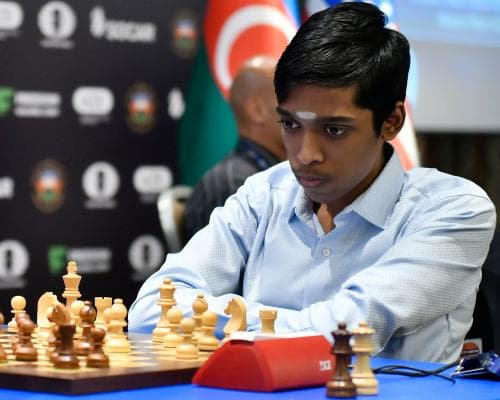
St. Louis is not the first place you'd look for a generational wealth transfer. But on a Thursday night in the Midwest, a 21-year-old from Chennai just took home a $200,000 check by outthinking a 34-year-old American who has spent two decades perfecting the art of the quiet kill. The event: the Grand Chess Tour finals. The winner: Praggnanandhaa Rameshbabu, who beat Fabiano Caruana 15-13 in a brutal mix of classical, rapid, and blitz games. This wasn't just a chess match. It was a live auction for the future of intellectual capital — and the bidding is getting richer.
The prize money alone tells you something is shifting. Praggnanandhaa's $200,000 first prize is up 33% from last year's $150,000, and it's on top of his Norway Chess win earlier this summer. That's a two-tournament haul of roughly $350,000 for a kid who isn't even old enough to rent a car in the U.S. But here's the kicker: he's not the only one cashing in. Wesley So, the U.S. world No. 6, took home over $100,000 for winning the Sinquefield Cup — his second straight — by playing what he openly called a 'bigger strategy' of early draws. So, 32, admitted he wasn't proud of the boring nine draws that opened his tournament, but he was proud of the payoff. That's not chess. That's portfolio management.
Let's get into the mechanics, because this is where the money story gets interesting. The Tour finals aren't a single game. They're a hybrid format where classical games count for six points, rapid for four, and blitz for two. That weighting is a deliberate bet on different skill sets — classical is the marathon, rapid is the sprint, blitz is the lottery. Caruana won the first classical game by exploiting a blunder at move 28. Praggnanandhaa then blew a bishops-of-opposite-colors ending in the second, allowing Caruana to survive a 95-move grind. But the young Indian won both rapid games to take an 11-9 lead, then held on in blitz. The final score: 15-13. What you're seeing here is a diversification strategy in action — Praggnanandhaa didn't try to beat Caruana at his own game. He shifted the risk profile to formats where his edge was sharper.
The rarity angle is the real asset. This is a 21-year-old who has now beaten the world No. 2 in a major final, and he did it with a 27-move win over France's Maxime Vachier-Lagrave that was the fastest victory of the Sinquefield Cup — a subtle 27...Bb6! that forced resignation. That's not just talent. That's a proprietary algorithm running at human speed. And the market is pricing it accordingly. The Grand Chess Tour's prize pool is now over $1 million across its events, and the top players are effectively running their own boutiques — hiring seconds, using AI analysis, and optimizing their schedules for peak cash flow. So, for instance, admitted he sacrificed style for substance, and it worked. That's what a hedge fund manager would call a risk-adjusted return.
For the wealthy, this signals something bigger than chess. The global market for 'brain capital' is exploding. Chess is just the most visible arena where a single individual can monetize cognitive skill at a scale that rivals mid-tier professional sports. The top players are now earning seven figures annually, and the money is flowing from sponsors, streaming deals, and prize funds. But the real wealth signal is in the demographic shift. Caruana is 34. Praggnanandhaa is 21. The average age of the top 10 is dropping, and the young players are not just better — they're more commercially savvy. They understand that a win is a product, a draw is a hedge, and a loss is a learning cost. That's a mindset that translates directly to capital markets, where the next generation of fund managers is already using similar tactics.
So what does this mean for your portfolio? Don't run out and buy chess-related ETFs — there aren't any. But do pay attention to the underlying trend: the value of pure intellectual output is rising, and the barriers to entry are falling. AI has democratized training, but it's also raised the floor. The players who are winning now are the ones who can combine human intuition with machine precision — and that's the same skill set that's driving alpha in quant funds, biotech, and even real estate development. The $200,000 check is nice, but the real money is in the signal. The next generation of wealth won't be built on oil or real estate. It'll be built on the ability to outthink the market, move fast, and know when to draw.
Praggnanandhaa's win is a stake in the ground. He's not just a chess prodigy. He's a proof of concept for a new asset class: young, agile, globally mobile brains that can be deployed anywhere, in any format, and monetized at scale. The old guard — the Caruanas, the Sos — are still formidable, but they're playing a game of preservation. The new guard is playing a game of expansion. And if you're a wealth builder, the lesson is simple: don't bet against the kid who can win in blitz, rapid, and classical. Because in the end, the market always pays for versatility.