Saudi Arabia reclaims MENA startup crown, but the debt behind the rebound tells the real story
MENA startups raised $172.6M in July 2026, with Saudi Arabia leading at $106.6M — but 56% came from debt, not equity.
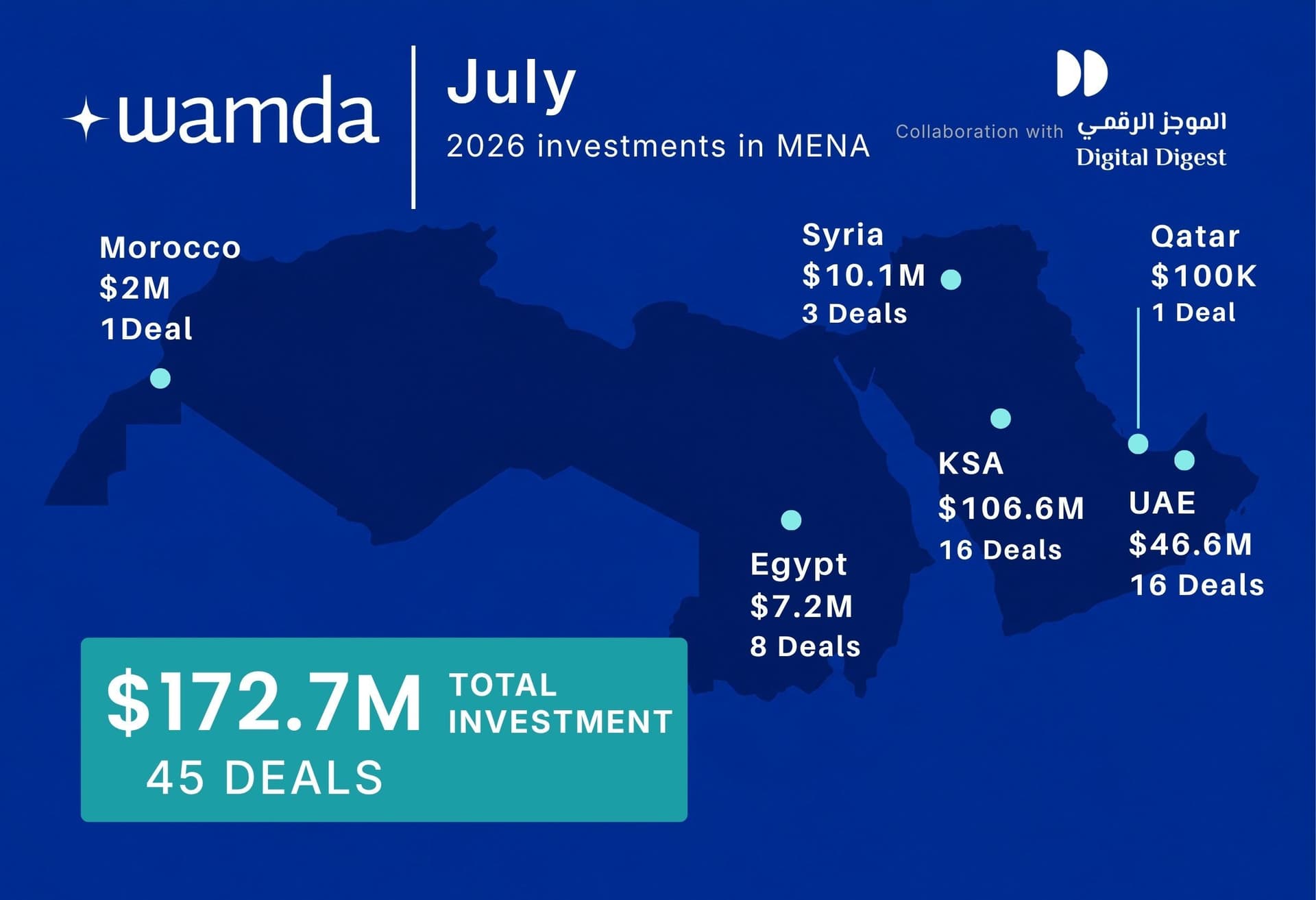
For anyone tracking where Middle East capital actually lands, July 2026 offered a paradox wrapped in a spreadsheet. MENA startups pulled in $172.6 million across 45 deals — a 16% bump from June that sounds like recovery until you hold it next to the same month last year, when the region raised 78% more. The headline is Saudi Arabia back on top. The subtext is that the comeback ran on debt, not conviction.
Saudi startups raised $106.6 million across 16 transactions, nearly 62% of the regional total, reclaiming the lead after a first half where the kingdom kept slipping in regional rankings. The UAE matched the deal count with 16 of its own but drew only $46.6 million, landing second. What stands out for a global reader is the composition: 56% of all July funding came in the form of debt, versus 11.5% in June and a mere 2% a year ago. Equity investors, in other words, are still holding their fire. They are not absent — 33 early-stage startups raised $49 million — but they are writing smaller cheques and demanding clearer revenue visibility, which is why B2B models swallowed 79% of all capital deployed.
The local context matters here. Saudi Arabia's Vision 2030 has turned the kingdom into the region's most aggressive state-backed venture engine, with sovereign funds and government-linked entities pushing startups toward scale. But July's numbers suggest that push is increasingly coming through lending instruments rather than equity stakes — a shift that protects downside for backers but loads startups with repayment obligations. The UAE, meanwhile, remains the preferred home for founders seeking global reach and later-stage capital, yet its July haul was barely half of Saudi's. Syria's emergence as the third-largest market, with $10.16 million across three deals, is a footnote that says more about Egypt's stumble — just $7.25 million across eight deals — than about Damascus becoming a hub. Morocco's $2 million and Qatar's estimated $100,000 round round out a deeply concentrated picture: Saudi and the UAE together commanded nearly 89% of all money raised, leaving the rest of the region to fight over $19 million.
Sector-wise, e-commerce grabbed 55% of July's funding, but that was driven by a handful of outsized transactions rather than a broad renaissance. Govtech's $15 million round for Whiteshield and two super app deals worth $12 million — one Syrian, one Moroccan — filled out the top three. Fintech, the perennial darling, slipped in value but still led in deal count with nine transactions worth $10.9 million, proving appetite remains even when cheques shrink. Proptech followed with eight deals at $11.9 million. The real signal, though, is the absence of any mega-round or late-stage financing. This is a market where early-stage investors are active but cautious, and where the lack of growth-stage capital risks creating a bottleneck — startups that can start but not scale.
The gender gap remains the ugliest number on the sheet. Female-founded startups raised $1.7 million across four deals, under 1% of the total, while male-founded teams took 97%. Mixed-gender teams managed $3 million. This is not a new story, but it is a persistent one, and it undermines every official narrative about inclusive innovation in the Gulf.
What July tells the international reader is that Middle East venture is in a holding pattern — debt is the bridge, equity is the destination, and no one is sure when the crossing ends. Saudi Arabia's return to the top is real, but it is a lead built on instruments that demand repayment, not risk-sharing. If the kingdom wants to cement its position as the region's capital magnet, it will need to coax equity back into the game. Until then, the smart money watches the debt-to-equity ratio as closely as the deal count, because one is a headline and the other is a health check. The second half of 2026 will show whether this is a pause or a pivot.


