Riyadh's LEAP turns five: $14.5 trillion in capital descends on the Gulf's AI moment
LEAP 2026 opens in Riyadh with 1,289 investors managing $14.5 trillion, AI focus, and a $1M startup prize — a milestone for Saudi tech ambitions.
For five years now, Riyadh has been quietly building the Middle East's answer to CES, and this week the bill comes due. LEAP 2026 opens on 31 August with a guest list that reads like a who's who of global tech — AMD's Lisa Su, Cisco's Chuck Robbins, and a parade of founders and fund managers who collectively sit on $14.5 trillion in assets under management. That number is not a typo, and it is not vanity. It is the clearest signal yet that Saudi Arabia's bet on becoming the region's AI and deep-tech hub has moved from aspiration to gravitational pull.
The fifth edition of LEAP stretches over four days and 16 stages, with more than 20 content tracks spanning AI, advanced computing, mobility, gaming and emerging tech. The headline speakers include Saudi Minister of Communications and Information Technology Abdullah Alswaha, whose presence underscores how deeply the state is woven into this event, alongside Su, Robbins, and Tareq Amin of HUMAIN. But the real story sits in the numbers that don't make the keynote reels: 1,289 investors from 1,016 firms, holding a combined $14.5 trillion in assets under management, are confirmed to attend. That is not a conference crowd. That is a capital market in motion.
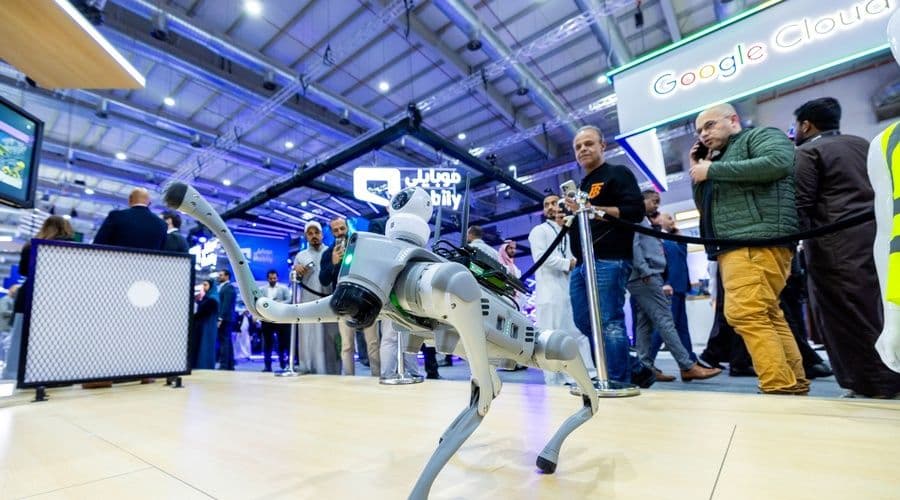
To understand why this matters, you have to understand what LEAP was not so long ago. Launched in 2022, it arrived as Saudi Arabia was still dusting off the early years of Vision 2030, a national programme that promised to diversify the economy away from oil. The first edition was ambitious but unproven — a tech show in a city not yet known for tech. Five years later, LEAP has become the region's dominant platform for matching Gulf money with global innovation, and this year's edition leans hard into what Riyadh calls the Year of AI. The programming reflects that: humanoid robots from Unitree and AGIBOT, brain-signal interfaces from COGNIXION, robotaxis and flying taxis in the Future Mobility Zone, and an interactive F1 experience tied to the Jeddah Corniche Circuit. This is not abstract talk about the future; it is a showcase of machines and systems that are already shipping.
The startup pipeline is where the event's real weight shows. Rocket Fuel, the pitch competition, drew more than 3,000 applications and will see 100 finalists compete for $1 million in equity-free prizes. That ratio — 30 applicants per prize dollar — tells you something about the hunger in the region's founder ecosystem, and about how seriously young companies take the chance to stand in front of investors who manage collectively more than the GDP of most countries. LEAP Connect and Ecosystem Xchange add quieter but crucial layers, letting founders and fund managers do business beyond the stage lights. And LEAP Nights, running from 30 August to 4 September across 60 events in more than 15 venues, turns the whole city into an extended networking lounge — a reminder that in the Gulf, deals are often closed over dinner, not on a convention floor.
For an international reader watching Middle East wealth, LEAP 2026 is a useful barometer. The event is no longer just a Saudi showcase; it is a magnet for global capital that sees the Kingdom as a gateway to the wider region. The presence of executives from NVIDIA, Google, Meta, Uber and Lenovo, alongside LaLiga's Javier Tebas, suggests that Riyadh is not merely hosting a trade show but brokering a convergence of technology, sport and entertainment — all sectors where Gulf sovereign funds have been deploying aggressively. The $14.5 trillion figure, repeated in official materials, is the kind of number that makes a CFO blink, but it also carries a subtext: this is where the money wants to be seen, and where it wants to be counted.
What happens after the exhibition halls close is the real test. LEAP has succeeded in making Riyadh a destination, but the deeper question is whether the deals struck here translate into companies built, factories opened and jobs created across the Kingdom. The Year of AI framing suggests the government wants more than photo opportunities — it wants deployment. The robots, the autonomous vehicles and the brain-computer interfaces on display are prototypes of an economy that Saudi Arabia is trying to will into existence. Whether that will is enough, and whether the global investors who flew in for four days will keep their capital in the country after the keynotes fade, is the story to watch. For now, though, the message from Riyadh is unambiguous: the Gulf's tech decade is not coming. It is here, and it has a very large checkbook.
More in MONEY