Nigeria's REITs post 63% rental income jump as UPDC leads property push
Nigeria's listed REITs see rental income surge 63% to N2.08bn in H1 2026, with UPDC leading an 87.6% rise as funds expand property portfolios.
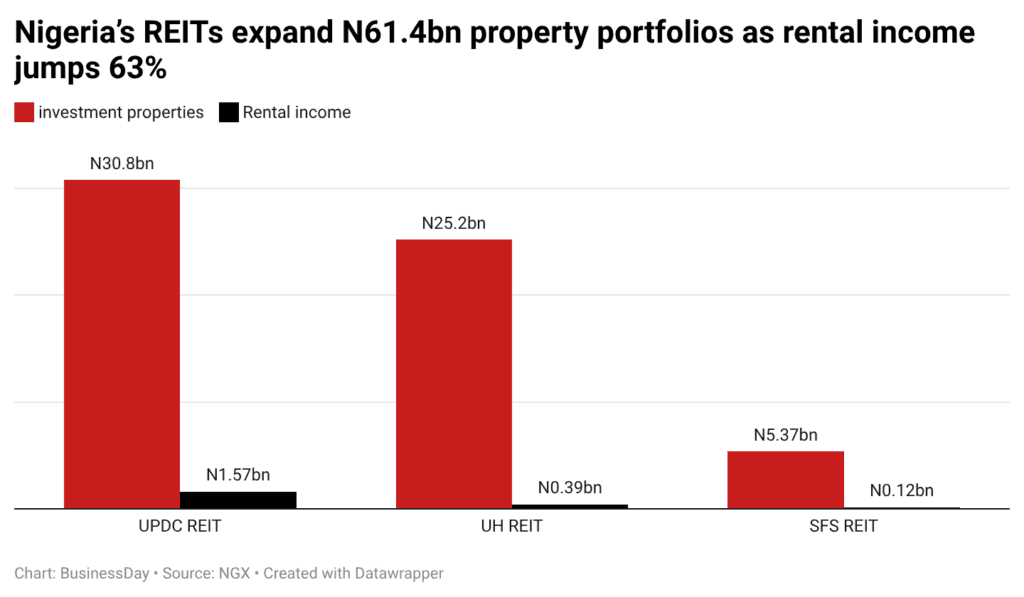
For anyone tracking where Africa's serious money is moving, the latest numbers out of Lagos deserve more than a glance. Nigeria's three listed real estate investment trusts — SFS REIT, UPDC REIT and UH REIT — just posted a combined 63 percent jump in rental income for the first half of 2026, pulling in N2.08 billion against N1.27 billion a year earlier. That is not a rounding error in a market where inflation and interest rates have been chewing through balance sheets. It is a signal that property funds are finally converting bricks into reliable cash flow, and doing so with conviction.
The standout is UPDC REIT, the oldest and most established of the trio, which nearly doubled its rental income year-on-year to N1.57 billion. That is an 87.6 percent leap from N837 million in H1 2025, and a 151 percent climb since H1 2022. UPDC's investment properties grew more modestly — from N27.4 billion to N30.8 billion — which makes the income surge all the more telling. The fund is not just buying more; it is squeezing far more out of what it already owns. Its rental yield on investment properties improved from roughly 3.1 percent to 5.1 percent, a meaningful gain for investors who have long complained about REITs behaving like sleepy savings accounts rather than growth vehicles.
UH REIT tells a different but equally important story. Its property portfolio exploded from N9.27 billion to N25.2 billion in just one year, a 171.8 percent expansion that marks a radical break from the flat trajectory it had held since 2022. Yet rental income only inched up 17.3 percent to N393 million. That gap between asset growth and income generation is the classic REIT conundrum: buying buildings is easy, filling them and collecting rent is the hard part. Investors will be watching whether UH can convert that new base into recurring revenue over the next few reporting cycles. SFS REIT, meanwhile, continues its steady grind — rental income up 16.2 percent to N122 million on a small N1.98 billion portfolio, proving that consistency has its own appeal in a volatile market.
To understand why this matters, you have to step back into Nigeria's broader property reality. Construction costs have soared, interest rates remain punishingly high, and inflation has eroded both disposable incomes and developer margins. The traditional model of buying land, building and flipping has become a trap for the impatient. REITs, by contrast, offer a way to own income-producing assets — office blocks, retail spaces, logistics warehouses — without the speculative risk of development. The sector's shift toward expanding investment property values and rental income suggests a maturing strategy: hold real assets, generate recurring cash, and let compounding do the heavy lifting. For pension funds and institutional investors, that is precisely the kind of predictable yield they have been starved of.
This also reflects a broader continental trend. Across Africa, from Nairobi to Accra, listed property vehicles are emerging as the preferred channel for institutional capital that wants real estate exposure without the headaches of direct ownership. Nigeria's REITs are still small by global standards, but the growth rates are anything but. UPDC's five-year rental income trajectory — from N625 million in H1 2022 to N1.57 billion now — shows what happens when a fund focuses on asset quality and tenant mix rather than chasing land banks. The 12.4 percent expansion in UPDC's investment properties to N30.8 billion, on top of the income surge, points to a virtuous cycle: better assets attract better tenants, which justifies further acquisitions.
The open question is whether UH REIT can close the gap between its ballooning property base and its lagging rental income. If it does, the sector's collective numbers could look even more impressive next year. If it does not, the divergence will raise uncomfortable questions about whether some funds are overpaying for assets in a market where vacancy risks remain real. Either way, the direction of travel is clear. Nigeria's REITs are no longer passive holders of legacy properties; they are active portfolio builders betting on urbanisation, formal retail and modern logistics. For the international investor scanning Africa for yield, these funds are starting to look like a serious entry point — not just a speculative side bet. The next half-year results will tell us whether the income keeps pace with the ambition.


