Nigeria's $200m migrant lifeline: Can agriculture bank turn displacement into development?
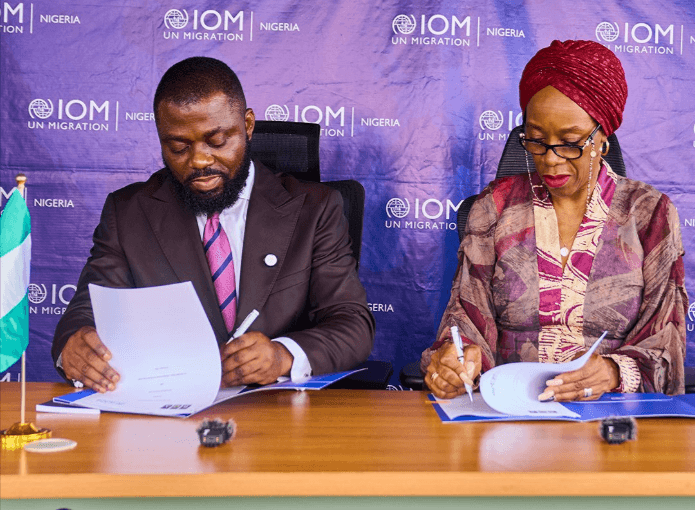
For the millions of Nigerians who have lost their farms, their homes and their footing to conflict and climate shocks, the promise of a paycheck has often felt like a distant rumor. This week, the country's Bank of Agriculture (BOA) signed a deal that aims to change that calculus, pairing a $200 million Livelihood Support Fund with the International Organization for Migration (IOM) to put displaced people back to work — not as aid recipients, but as producers.
The memorandum, signed in Abuja by IOM's Deputy Director General Ugochi Daniels and BOA's Managing Director Ayo Sotinrin, is more than a handshake between bureaucrats. It is a bet that agricultural finance can absorb some of Nigeria's most fragile populations. The fund will target internally displaced persons (IDPs) and migrants, offering them agricultural inputs, training, financial inclusion and market links — the raw tools needed to restart a life after losing everything. Nigeria currently hosts over 3.5 million IDPs, many of whom have been cut off from land and income by Boko Haram violence in the northeast, farmer-herder clashes in the middle belt, and flooding that has swallowed entire harvests.
To understand why this matters, you have to know the Bank of Agriculture. It is not a commercial lender chasing profit; it is Nigeria's oldest state-backed development finance institution, created to push credit into rural areas where commercial banks fear to tread. For decades it has been the quiet engine of smallholder farming, often underfunded and overlooked. This deal changes its profile. It comes barely five weeks after BOA secured a $1 billion intervention fund aimed at transforming smallholder agriculture from seed to market — a signal that the government is finally treating rural credit as a national security issue, not a charity line item.
The IOM partnership is cleverly framed around self-reliance. Daniels put it plainly: by linking migration management with development financing, the aim is to create opportunities that let people rebuild their lives and reduce aid dependency. That is a sharp departure from the old model of handing out food baskets in camps. Instead, the fund treats displaced farmers as assets — people who, given capital and connections, can feed themselves and their neighbors. Sotinrin called it an investment in people and national stability, a phrase that resonates in a country where food inflation has fueled anger and where empty stomachs have historically translated into political unrest.
This is also a test case for the rest of the continent. Africa hosts more than a third of the world's internally displaced people, and most of them live in rural areas where agriculture is the only viable livelihood. If Nigeria can prove that a development bank can successfully lend to people who have been uprooted — and get repaid — it could become a template for the African Union's Agenda 2063 goals of resilience and inclusive growth. The United Nations Sustainable Development Cooperation Framework is already watching, and the model is migration-sensitive by design, meaning it could be exported to the Sahel, the Horn of Africa, or the Lake Chad basin.
The hard part, of course, is execution. Disbursing loans to people without collateral, without land titles and often without formal identity documents is a logistical nightmare. But the bank has a network of rural branches and decades of experience with smallholder credit, even if its past performance has been uneven. The $200 million is modest relative to the scale of need, but it is a start — and it is paired with a much larger $1 billion fund that could provide the backbone for a real agricultural recovery.
What happens next will be watched closely by every finance minister in the region. If Nigerian IDPs can turn plots of borrowed land into marketable harvests, the narrative shifts from displacement as a tragedy to displacement as a managed transition. That would be a genuine breakthrough — not just for Nigeria, but for a continent learning that the best social safety net is a functioning farm.