Juli Plc's Shrinking Empire: A Nigerian Distributor's Fight to Stay Relevant
Juli Plc narrows H1 loss to N12.86m despite an 83% revenue plunge, revealing a stark tale of cost-cutting survival in Nigeria's pharma distribution sector.
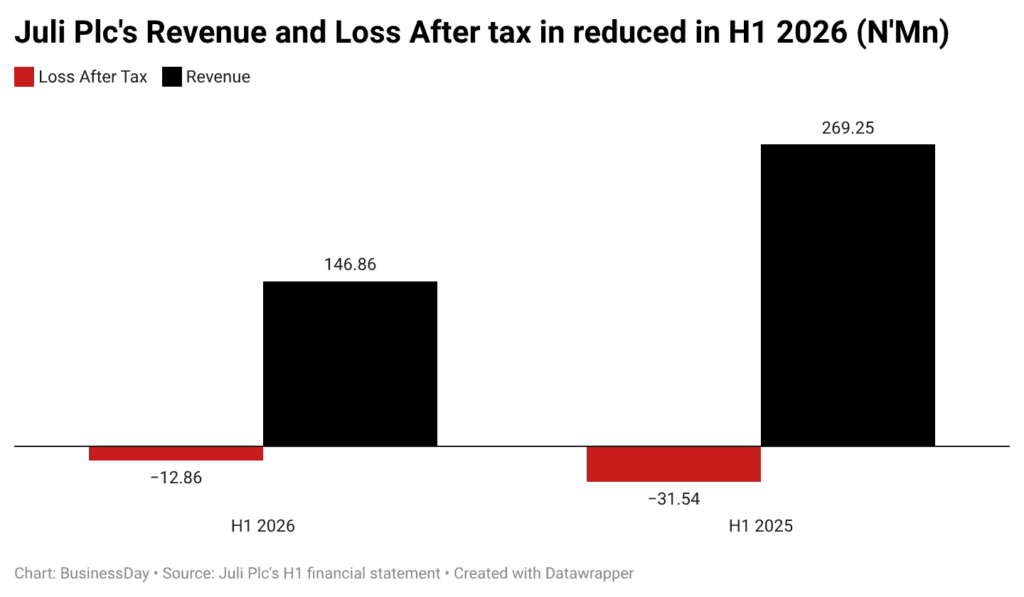
For anyone tracking the quiet corners of Nigerian capital markets, Juli Plc's latest numbers are less a financial report and more a distress signal wrapped in a survival manual. The Lagos-based pharmaceutical and consumer goods distributor has managed to narrow its after-tax loss by 59.2 percent to N12.86 million in the first half of 2026, down from N31.54 million a year earlier. That sounds like progress, until you see the top line: turnover collapsed by 83.3 percent to just N146.8 million, a catastrophic fall from the N269 million booked in H1 2025. This is not a company growing out of trouble; it is a company shrinking into a smaller, more disciplined version of itself, hoping to live another day.
Juli Plc is not a household name like Nestle or Dangote, but it occupies a specific, unglamorous niche in Nigeria's pharmaceutical supply chain. It distributes drugs, lab equipment, and fast-moving consumer goods to hospitals, pharmacies, and retailers across the country's chaotic wholesale markets. The company's three business segments all bled revenue in the period: laboratory goods dropped 75.5 percent, pharmaceuticals fell 46.2 percent, and consumer goods slid 40.3 percent. That across-the-board decline tells you the problem is not a bad product line or a lost contract; it is something structural, likely a combination of naira volatility, shrinking consumer purchasing power, and the brutal reality that Nigeria's informal drug market is being squeezed by both inflation and regulatory pressure.
The only reason Juli is not drowning is aggressive cost-cutting. Management slashed administrative expenses by nearly half and reduced the cost of sales so aggressively that the gross profit margin held at 33.1 percent. But this is a diet that starves the patient. The balance sheet has slimmed down 27 percent year-on-year to N143 million, driven by depleted inventories — meaning the company is selling off what it has and not restocking. Equities have swung to a deficit of N30.2 million, while retained losses ballooned to N867.5 million. The stock market has noticed: shares are down 10 percent year-to-date, and the entire company is valued at just N1.5 billion, a pittance for a firm that once had a meaningful distribution footprint.
What Juli's story signals about African wealth is uncomfortable but essential. The old model of middleman distribution — buying goods on credit, warehousing them, and selling to smaller traders — is dying across the continent. In Nigeria, the combination of currency devaluation, high borrowing costs, and the rise of direct-to-retail digital platforms is crushing these intermediary businesses. Juli is not alone; dozens of similar listed micro-caps on the Nigerian Exchange are posting the same pattern: revenue evaporates, management cuts costs, losses narrow, but the company never regains its former size. They are zombies, kept alive by the discipline of cost control but incapable of growth.
The deeper context is that Juli's struggles mirror the wider formal economy's squeeze. When a distributor's payables increase while it deleverages on debt, it suggests suppliers are extending credit out of desperation, not confidence. The company's retained losses eating into equity is a warning sign for minority shareholders, who are watching their investments erode in real terms. For an international reader, the lesson is this: in Africa's most populous economy, the middle of the value chain is being hollowed out. The winners are either the largest importers with hard currency access or the smallest informal traders who operate outside formal accounting. Companies stuck in between, like Juli, are fighting for survival by shrinking.
Looking forward, Juli's path is narrow. It could pivot to becoming a last-mile logistics partner for multinational pharmaceutical firms that want to bypass traditional wholesalers, or it could merge with a larger player seeking distribution reach. But without a revenue revival, cost-cutting alone will eventually hit a floor. The company's N1.5 billion market cap makes it a potential takeover target, and in Nigeria's current M&A climate, where cash-rich conglomerates are snapping up distressed assets, that might be the most realistic exit. For those who follow African capital, Juli Plc is a case study in how quickly a business can go from distribution kingpin to a penny-stock survivor — and a reminder that in this economy, sometimes the best you can do is lose less, not win more.