Gaza's New Currency: Why Trump's Peace Plan Is a Bet on Disarmament Economics
Trump's Board of Peace is pushing a 15-point Gaza plan that ties Israeli withdrawal to Hamas disarmament, a high-stakes negotiation with direct implications for regional stability and the capital flows that follow peace. For wealth builders, the outcome will determine whether reconstruction dollars flood into Gaza or remain frozen in geopolitical limbo.
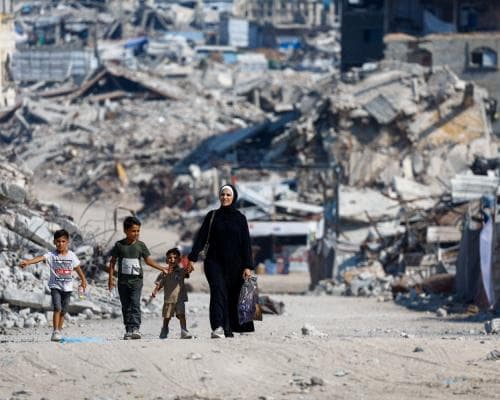
The most expensive real estate on Earth right now isn't in Manhattan or Monaco. It's a strip of land smaller than Las Vegas, where the price of a single square meter is measured not in dollars but in the will of two enemies to trust each other. And this week, Donald Trump's handpicked peace brokers are trying to close the deal.
On Sunday, in Cairo, Trump's Board of Peace envoy Nickolay Mladenov sat down with Egyptian, Qatari, and Turkish mediators, with Hamas leader Khalil Al-Hayya reportedly in the room for some sessions. The goal: advance a 15-point plan that would see Hamas hand over its weapons in exchange for a full Israeli military withdrawal and a transition to an independent Palestinian National Committee. It's a blueprint that, if executed, would reshape not just geopolitics but the entire investment calculus for the region.
The numbers behind this negotiation are staggering. Gaza's reconstruction bill is estimated at $50 billion or more, according to UN and World Bank assessments. That's the kind of figure that makes sovereign wealth funds salivate and infrastructure investors sharpen their pencils. But none of that money moves unless the guns go quiet first. That's the brutal arithmetic of peace economics: capital follows certainty, and right now, Gaza is the definition of uncertain.
Here's the mechanical problem. Netanyahu has publicly rejected the 15-point document, insisting that the IDF won't pull out until Hamas is 'genuinely disarmed'—meaning heavy weaponry, lighter weaponry, all weaponry, as he put it. Hamas, meanwhile, says it will only hand over its arms after Israel ends 'all forms of aggression' and withdraws. It's a classic prisoner's dilemma, but with tanks and rockets instead of jail time. The mediators in Cairo are trying to break that deadlock with sequencing: stages, timelines, verification mechanisms. But so far, the only thing moving is the clock.
For the wealthy and the markets, this isn't just a humanitarian story. It's a signal test. When peace plans advance, you see it in the price of Israeli bonds, in the shekel, in the risk premium on regional energy routes. When they collapse, you see it in the spikes of gold and oil. The current ceasefire, fragile as it is, has already allowed some trade and aid to trickle through, but the markets are pricing in a long, grinding status quo. The real money—the big infrastructure contracts, the port rebuilds, the tech zones that were once floated for Gaza—stays on the sidelines, waiting for a signature that hasn't come.
What makes this moment different is the personality at the center. Trump's Board of Peace isn't a typical diplomatic apparatus; it's a deal-making machine, built on the premise that economic incentives can trump historical grievances. The plan's logic is pure transactional: disarmament as a down payment, withdrawal as a conditional release, and reconstruction as the lucrative exit. It's the kind of thinking that works in boardrooms, but Gaza is not a boardroom. The heritage of this conflict is littered with similar blueprints that ended up as footnotes.
Yet here's the angle that wealth builders should watch. If the plan somehow sticks—even in a modified form—the first movers will be the Gulf sovereign funds, particularly Qatar, which has already bankrolled much of Gaza's governance. They have the liquidity, the patience, and the political cover to enter first, snapping up ports, energy assets, and housing projects at distressed valuations. The second wave would be Western pension funds and infrastructure giants, but only after a verified disarmament and a stable security framework. The third wave? That's the speculative capital, the kind that chases headlines, and it'll be the most volatile.
For now, the market direction is stable—but that's the kind of stable that precedes a cliff. Every air strike, every failed round of talks, pushes the region closer to a hard reset. The smart money is watching the Cairo meetings not for press releases but for the quiet details: who shakes hands, who stays in the room, who leaves early. Because in this negotiation, the real currency isn't the dollar or the shekel. It's trust. And right now, trust is trading at a steep discount.


