India's $30 Trillion Green Bet: Can a Nation Decarbonize While It Develops?
In April, on a single day, every one of the planet’s top 50 hottest cities was in India. That’s not a weather report; it’s a warning shot. The world’s most populous nation is trying to do something no major economy has ever done: expand GDP nearly eightfold within a generation while simultaneously pivoting its entire energy and industrial base to net zero within two. The policy thinktank Niti Aayog calls it a path with “no historical precedent.” It’s not hyperbole. China industrialized at vast scale, but not on a sustainable path. Japan, Korea, and Europe got rich first, then cleaned up. India has to do both at once, and the clock is ticking.
This is the defining challenge of the next quarter-century, and it’s not just an Indian story. It’s a global test of whether the climate crisis can be solved without condemning billions to poverty. The report assumes India reaches a $30 trillion GDP by 2047, with rising urbanization, industrialization, and living standards. That would mean adding the equivalent of another United States to the world economy, but doing so while slashing emissions intensity. The stakes are existential: if India fails, so does the Paris Agreement. If it succeeds, it becomes the blueprint for every developing nation from Nigeria to Indonesia.
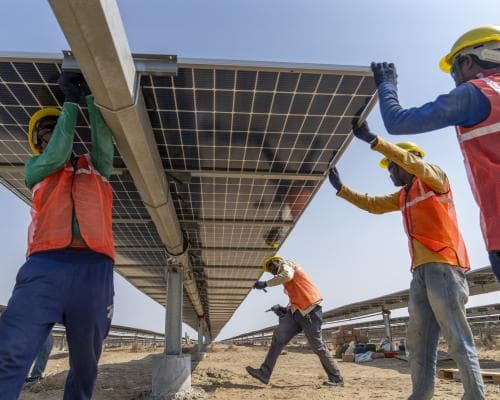
The technology is already there. Solar costs have plummeted, batteries are getting cheaper, and green hydrogen is inching toward viability. India has also made real progress: non-fossil fuel sources now account for more than half of installed electricity capacity. But the devil is in the grid. Coal still fires up at peak demand, especially during heatwaves, creating a vicious feedback loop: heat drives cooling demand, cooling demand drives coal-burning, and coal-burning drives temperatures higher. The solution isn’t just more renewables; it’s storage, smart grids, and a complete overhaul of how power is priced and distributed. That’s where the private sector comes in.
The report leans heavily on private finance, but it leaves a crucial question unanswered: who bears the cost of the transition, and who captures the gains? India’s state-owned banks are already strained, and foreign capital is skittish about regulatory uncertainty and currency risk. The government has courted billionaires and global funds, but the sums needed are staggering. The International Energy Agency estimates India needs over $1.4 trillion in clean energy investment by 2040. That’s not a gap; it’s a chasm. The report’s logic is that fast growth will attract investment, which will fuel more growth, creating a virtuous cycle. But that assumes the capital flows to green projects, not to the next coal plant or highway.
This is where the real bet lies. India is not just betting on technology; it’s betting on a new model of development. Unlike the West, which enjoyed cheap fossil fuels for centuries, India must leapfrog straight to a clean-energy economy. That means building entire industries—from solar manufacturing to EV batteries to green steel—from scratch, often without the benefit of scale or supply chains. The competitive context is brutal: China dominates solar and battery production, and the US and EU are pouring subsidies into their own green industries. India risks being squeezed between cheap Chinese imports and protectionist Western markets, unless it can carve out a niche in innovation and services.
But there’s a reason for optimism. India has a history of leapfrogging—from skipping landlines to embracing mobile phones, from missing the industrial revolution to becoming a software superpower. Its engineers and entrepreneurs are world-class, and its domestic market is vast. If anyone can pull off this high-wire act, it’s India. The next decade will be the proof. Will the government create the policy stability and infrastructure to attract patient capital? Will Indian billionaires—like Mukesh Ambani and Gautam Adani—pivot their empires from fossil fuels to green energy? Ambani has already pledged $10 billion to clean energy, and Adani has announced massive solar and hydrogen projects. But these are the same tycoons who built their fortunes on coal and gas. The transition will be messy, and it will be political.
Ultimately, India’s green growth gamble is a test of faith—in markets, in technology, and in the ability of a democracy to make hard choices. The alternative is a future where India grows rich on coal, and the planet burns. The world is watching, and the stakes couldn’t be higher. If India succeeds, it will redefine what’s possible. If it fails, we’ll all feel the heat. The next few years will tell us which path we’re on.
More in INNOVATION