Dangote Takes Its Refinery IPO to Nairobi as Lamu Land Fight Simmers
NGX Group's Umaru Kwairanga courts East African institutions for Dangote's refinery IPO, as a $15–17bn Lamu plant faces a land dispute.
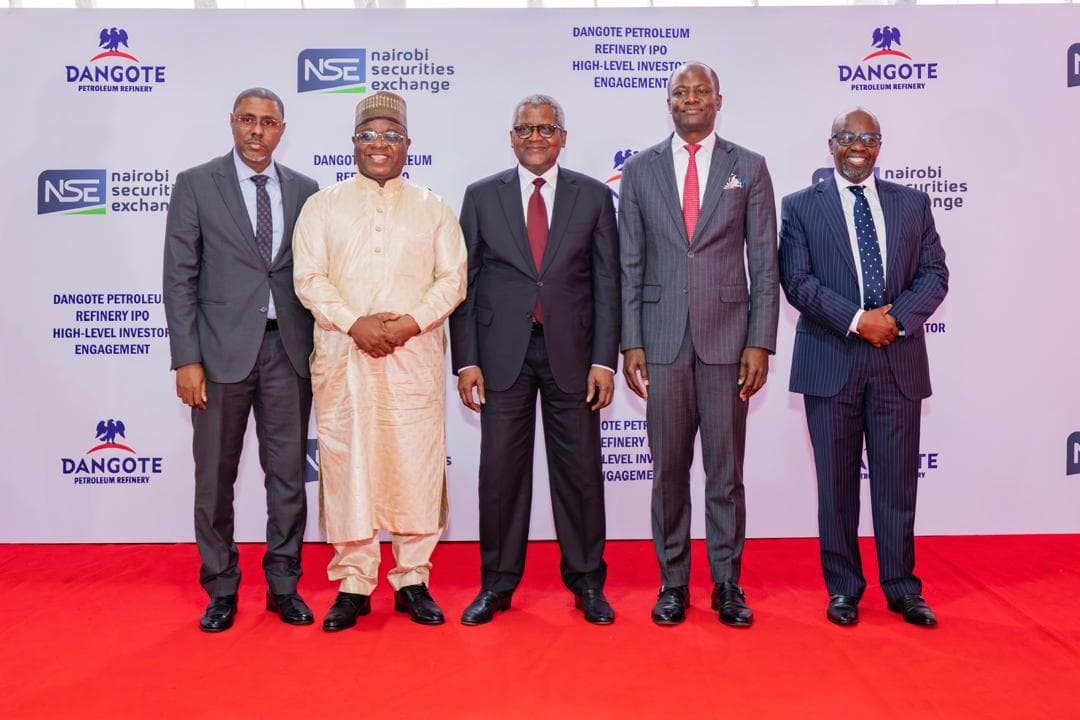
Nairobi's trading floor is not where you would expect to find the next chapter of Nigeria's biggest industrial story. Yet on Tuesday, September 29, 2026, the chairman of Nigerian Exchange Group, Umaru Kwairanga, stood before Kenyan and East African institutional investors at the Nairobi Securities Exchange to sell them a piece of Dangote Petroleum Refinery — and, more quietly, a thesis about who should own Africa's heavy industry.
The occasion was an investor engagement for the refinery's initial public offering, which opened on September 14 and closes on October 13. The offer comprises 4.1 billion ordinary shares at N525 each, a raise of roughly N2.15 trillion if fully subscribed, with a minimum subscription of 10 shares, or N5,250. Dangote is casting its net wide: it is targeting as many as 10 million retail investors. Kwairanga's message to the Nairobi room was blunt — East African institutions should put capital behind Dangote's continental build-out, including a planned refinery in Kenya. He argued that the Lagos refinery has already shown what large-scale African industrial investment can do, and that raising a big share of financing from African investors reduces dependence on expensive, unpredictable foreign money.
For outsiders, the Dangote name needs little translation inside Africa. Aliko Dangote built a business empire spanning cement, sugar, fertiliser and now refining, and his Lagos refinery — a 650,000 to 700,000 barrel-per-day complex — was for years the emblem of African self-sufficiency in fuels. The Kenya plan is bigger still: a refinery in Lamu estimated at $15 billion to $17 billion, designed to process 700,000 barrels of crude per day for Kenya and the wider East African market, with construction expected to take three to four years and commissioning targeted around 2030. Dangote has offered regional governments the chance to take equity, with disclosures indicating East African states could collectively hold up to 30%. The group is also expanding Lagos, aiming to double capacity to about 1.4 million barrels per day by around 2029 at a cost of about $14.3 billion.
The timing is awkward, and that is the part worth watching. On the eve of the Lamu groundbreaking, the Malindi Environment and Land Court ordered that the status quo be maintained on a disputed parcel, L.R. No. 13061, in the Hindi/Manda Magogoni area of Lamu County, until an inter partes hearing on October 14. The case was brought by 133 residents claiming long-standing occupation, cultivation and use of the land. Dangote said the ruling would not stop the groundbreaking ceremony, though some site activities could be affected. Land tenure is the fault line running under much of Africa's large-project pipeline, and Lamu — a UNESCO-listed coastal county with fishing and farming communities — is a sensitive place to test it.
What Kwairanga is really selling is a shift in how African capital circulates. Nigeria and Kenya both have deep institutional investor communities, and the NGX chairman framed the Nairobi meeting as part of a broader effort to move African savings into African businesses and link the continent's exchanges. That is a notable pitch from a Nigerian exchange chief on Kenyan soil: cross-border listings, shared market infrastructure and institutional partnerships are still rare on a continent where capital often routes through London, Dubai or New York before coming home. If Dangote can pull East African pension funds and insurers into a Nigerian refinery IPO, it becomes a template — and a test of whether African capital markets can finance African industry at scale.
The next few weeks will tell. The IPO closes on October 13; the Lamu land case returns to court on October 14. Between those two dates sits the question of whether Dangote's East African refinery is a groundbreaking or a cautionary tale — and whether the investors who heard Kwairanga in Nairobi decide that the continent's biggest industrial bet is one they want to own.


