Dangote IPO and pension reforms set to reshape Nigeria’s N34.5trn retirement pool
Nigeria's pension assets projected to hit N34.5trn by Dec 2026, driven by Dangote Refinery IPO, infrastructure fund, and reforms.
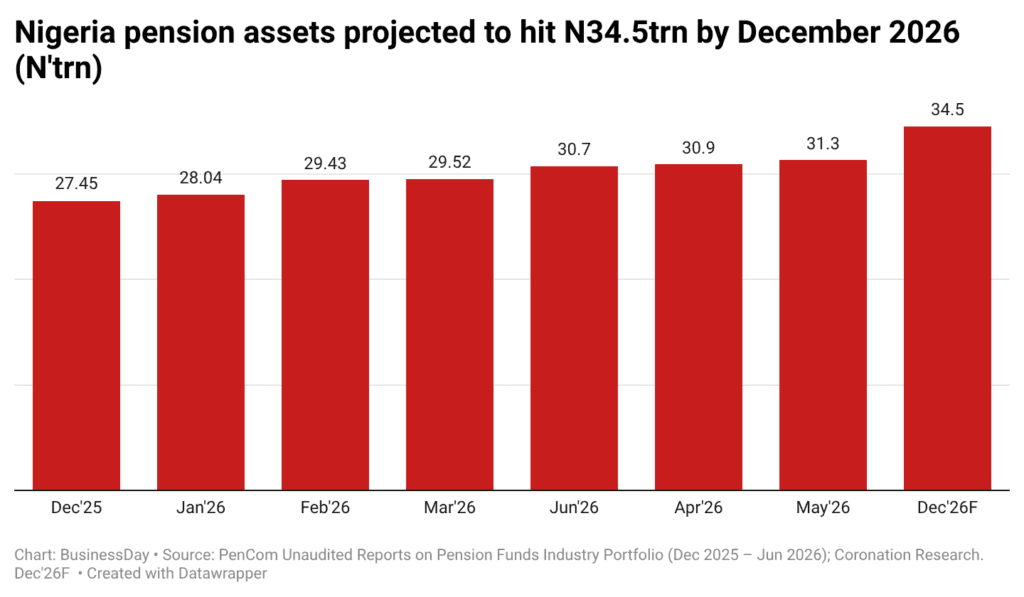
For anyone tracking the movement of serious money in Africa, the next few months in Lagos will be a masterclass in how a nation’s savings can be rewired. Nigeria’s pension industry, already a formidable pool of long-term capital, is bracing for a second half of 2026 that could see its assets swell to as much as N34.5 trillion by year-end. That projection from Coronation Asset Management lands even after a rare monthly dip in June—a blip the firm dismisses as a market correction, not a crack in the system. The engine of this growth? A mix of a landmark listing, a push into infrastructure, and a regulatory overhaul that could change how every working Nigerian saves for old age.
The numbers tell the story of a sector finding its stride. Pension assets had climbed for five straight months, from N27.45 trillion in December 2025 to a record N31.32 trillion in May, before a N623.6 billion (2%) pullback in June. The first half still closed with a hefty N3.25 trillion gain, an 11.8% jump that took the total to N30.70 trillion. Coronation’s outlook for December 2026—between N33 trillion and N34.5 trillion—signals a moderation, but not a stall. The June dip, they argue, was a natural breather after a hot streak, with the All-Share Index rebounding about 7% in July. The real catalysts, though, are not broad market rallies but specific, high-impact events.
At the center of it all is the Dangote Refinery IPO, a listing that could be the single biggest moment for pension investors this year. The refinery, the brainchild of Africa’s richest man, Aliko Dangote, has already pulled off a $2.5 billion pre-IPO placement that was 3.7 times oversubscribed, valuing the company at around $39.1 billion. The public listing is targeted for September, and pension fund administrators (PFAs) have been given a one-off waiver by the regulator, PenCom, to participate even though the refinery doesn’t meet all the usual eligibility rules. Coronation expects PFAs to dip in cautiously, using cash buffers and money-market holdings rather than selling off existing equities. This is not just about one deal—it’s about adding a heavyweight industrial name to the Nigerian Exchange, which could lure other companies to list. As the report notes, the exchange suffers from a thin free float relative to the fast-growing pension pool; without fresh supply, pension money risks inflating valuations rather than broadening the market.
Infrastructure is the other big piece of the puzzle. The long-awaited Pension Industry Infrastructure Fund (PIIF) is nearing a decision, with PenCom expected to rule on the framework by August or September and a pilot possible before year-end. The potential is enormous: infrastructure funds held by PFAs stood at just N329.4 billion in June, barely 1% of total assets, even though regulatory ceilings allow much more. The problem, Coronation argues, has never been a lack of regulatory permission but a shortage of bankable projects that meet pension-fund standards. A professionally managed pooled vehicle could finally bridge that gap, channeling Nigeria’s long-term savings into roads, power, and other critical infrastructure. That would be a game-changer for a country where the gap between savings and development needs is a constant refrain.
Then there’s the reform of the Pension Reform Act 2014, which could lift contributions and expand coverage. At the July Pension Consultative Forum, PenCom’s Director-General floated an increase in the employer’s contribution rate—currently 10% of monthly emoluments, with employees at 8%. Draft amendments are expected in the second half, with debates over tax implications, enforcement, police pensions, and the adoption of the contributory scheme by more states. Only eight of Nigeria’s 36 states have signed on so far, leaving a vast reservoir of potential contributors untapped. If reforms push more states and employers into the system, the pension pool could grow even faster than projected.
For the international reader, this is more than a Nigerian story. It’s a signal that Africa’s largest economy is maturing its capital markets, using domestic savings to fund big-ticket projects and corporate expansion. The Dangote IPO, the infrastructure fund, and the reforms are all pieces of a broader effort to make pension capital work harder. The risk, of course, is that the market’s supply of quality listings doesn’t keep pace with demand, leaving pension funds chasing a few assets. But with the refinery listing and infrastructure push, the second half of 2026 could set a template for how other African economies harness their pension pools. For those watching wealth and capital flows, Lagos is the place to be.


