The Arctic’s New Ghost Fleet: Where Luxury Travel Meets a Changing Sky
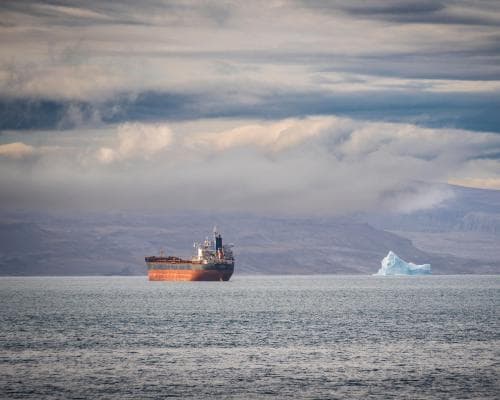
There is a new kind of contrail in the Arctic sky, and it does not come from a private jet. It comes from a cargo ship—one of hundreds now threading the Northwest Passage where ice once stood firm. Over the past twelve years, marine traffic in the region has surged by roughly 40 percent. And where the ultra-wealthy once came to witness a pristine, silent world, they are now arriving to find something else: clouds forming in places where the air used to be impossibly clear.
This is not the kind of detail you will find in a glossy brochure. But it is the kind of detail that matters when you are paying six figures for a polar expedition that promises the last untouched frontier. The science is stark and strange. Researchers at the École Polytechnique Fédérale de Lausanne have published findings in Environmental Research Letters showing that aerosol particles from ship exhaust act as nuclei for water droplets, seeding clouds in a sky that was historically too clean for such formation. In winter, the Arctic air is already hazy with industrial pollutants blown in from Europe and Asia, so the extra particles make little difference. But in summer—when the luxury yachts and expedition cruisers arrive—the air is crystalline. And that is precisely when a single vessel can change the weather.
Consider the irony. The same warming that allows these ships to sail north is being accelerated by their passage. The clouds they create trap more heat, a phenomenon known as radiative forcing. More heat means more melting ice. More melting ice means more ships. The loop is elegant and terrifying. For the discerning traveller, this transforms the Arctic from a scenic backdrop into a living, changing system—one that demands a new kind of attention.
The shift is already reshaping how the most exclusive polar operators plan their voyages. Some now schedule departures to avoid peak shipping lanes, seeking out pockets of true isolation. Others have begun offering on-board lectures by climate scientists, turning the journey into a floating seminar on the very forces reshaping the ice. The price of such a trip? From $50,000 for a ten-day charter on a refurbished research vessel to over $200,000 for a custom itinerary aboard a private ice-class superyacht. The true cost, however, is measured in the atmosphere.
What this signals about luxury travel is a quiet but profound recalibration. The wealthy have always sought the edge of the map—the place where the world ends and the unknown begins. But the unknown is now moving. The Arctic is no longer a static museum of ice and silence; it is a dynamic, fragile, and increasingly crowded corridor. The new luxury is not just access—it is understanding. It is the ability to witness change without accelerating it, to stand on the deck and watch a cloud form over a melting berg, knowing that you are part of the story, whether you like it or not.
Where the wealthy go next is not simply north. It is deeper. Deeper into the science, deeper into the ethics, deeper into the experience of a planet in flux. Some are already booking voyages that combine polar exploration with carbon-offset programs so aggressive they effectively scrub the journey from the ledger. Others are turning to hybrid-electric expedition ships that slip through the water with barely a whisper, leaving no trail of particles behind. The future of Arctic travel will belong to those who can navigate not just the ice, but the consequence of their own passage.
The Arctic is still the most beautiful place on Earth—if you know how to look at it. But the sky above it is no longer empty. It is full of stories, written in vapour and cloud. And the most discerning travellers are learning to read them.