The Straits of Power: Why the World’s Most Coveted Voyage Now Runs Through a War Zone
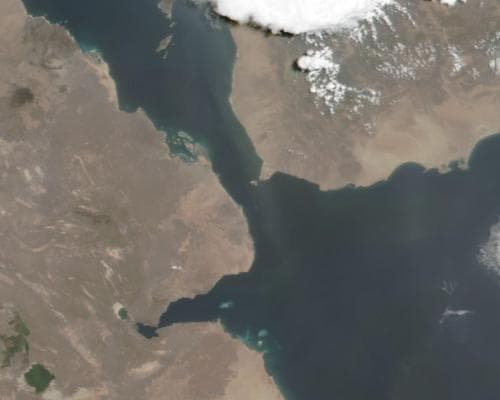
The email arrived on a Monday, crisp and clinical, like a summons from a shadow court. It warned shipping companies not to load or unload at Saudi ports — or else. By Thursday, Brent crude had breached $100 a barrel for the first time in months, and the Bab al-Mandab strait, that narrow, ancient corridor between the Arabian Peninsula and the Horn of Africa, had become the world’s most expensive choke point. For the ultra-wealthy, however, the real cost is not measured in barrels. It is measured in access. In possibility. In the quiet, urgent question: where can we still go when the map itself is on fire?
Consider the geography. The Bab al-Mandab — Arabic for “Gate of Tears” — is a 20-mile-wide passage that funnels roughly 4.1 million barrels of crude and refined products each day, about 5 percent of global seaborne oil. But for the traveler who has already chartered a superyacht through the Suez Canal, who has anchored off the coral gardens of the Farasan Islands, who has sipped mint tea in a private dhow off the coast of Djibouti, this strait is not a statistic. It is the gateway to an entire hemisphere of experience. And now, with Houthi militias threatening to target any vessel bound for Saudi ports, that gateway is narrowing.
What does this mean for the discerning voyager? It means the old certainties — the smooth, unimpeded passage from the Mediterranean to the Indian Ocean, the lazy drift past Yemen’s Socotra archipelago, the champagne-soaked sunset at the mouth of the Red Sea — are suddenly laced with tension. It means that the kind of journey that once required only a captain and a credit card now demands a geopolitical strategist. The ultra-wealthy are not abandoning the region. They are reimagining it. Private maritime security firms report a surge in inquiries from owners of vessels over 50 meters, seeking discreet, armed escorts for transits through the Bab al-Mandab. Some are rerouting entirely, opting for the long, slow passage around the Cape of Good Hope — a detour that adds weeks but removes risk.
Yet here is the paradox: danger, for a certain echelon of traveler, is a luxury commodity. The same Houthi threats that spook commercial shipping have, in recent years, drawn a niche cohort of expedition operators to the waters off Yemen. They offer voyages to the Socotra archipelago, a Unesco World Heritage site of dragon’s blood trees and limestone caves, accessible only by sea and only during the calm of the November-to-March monsoon window. These trips, priced from $15,000 a week on a liveaboard, are marketed not despite the instability but because of it. “Socotra is one of the last places on Earth that feels genuinely undiscovered,” a veteran expedition leader told me last year. “The Houthis make the insurance expensive, but they also keep the tourists away.”
Now, even that calculus is shifting. The Bab al-Mandab blockade threat is not a distant tremor — it is a direct hit on the logistics of luxury. The strait carries not just oil but also the refrigerated containers of Wagyu beef, the crates of Burgundy, the spare parts for a Gulfstream. When the Houthis warn that six ships have already changed course, they are redrawing the supply lines that stock the world’s most exclusive resorts. The St. Regis in Doha, the Four Seasons in Dubai, the private island retreats of the Maldives — all depend on the free flow of goods through these waters. A sustained blockade means higher prices, longer waits, and a new kind of scarcity: the scarcity of the seamless.
For the truly mobile, the response is not to wait but to pivot. I am hearing from private-jet brokers that requests for overflights of the Arabian Peninsula have dropped; instead, clients are routing through East Africa, landing in Nairobi or Zanzibar, then chartering smaller vessels to explore the untouched coastlines of Mozambique and the Quirimbas archipelago. The luxury travel industry is watching the Bab al-Mandab with the same intensity it once reserved for the Strait of Hormuz. And the lesson is clear: the next great frontier for the ultra-wealthy is not a place on a map — it is the ability to move through a world that is closing in.
So where do the wealthy go next? They go where the water is still open, where the insurance is still affordable, where the horizon is not a blockade but an invitation. They go to the Seychelles, to the Maldives, to the remote atolls of the Chagos Archipelago. They go to Antarctica, where the only strait that matters is the Drake Passage, and the only politics is the weather. But they also watch the Gate of Tears, because they know that luxury, at its highest level, is not about owning the rarest watch or the fastest car. It is about owning the freedom to move — and that freedom, like oil, has just become a hundred dollars a barrel.