Chess's Teenage Wunderkinds Are Rewriting the Rules of Genius
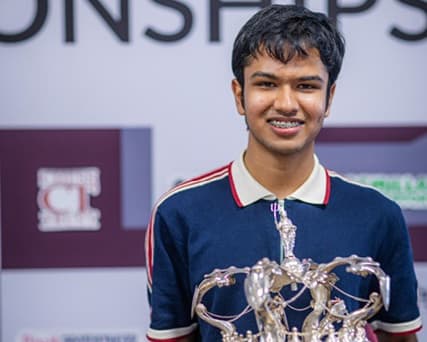
The old guard didn't just lose. They were out-computed. At the University of Warwick, Coventry, 17-year-old Shreyas Royal sat across from grandmasters who had dominated British chess for decades — and he dismantled their assumptions with a performance rating of 2688, a whisker from the elite 2700 threshold. Royal's 7.5/9 score made him the youngest British champion in history, breaking Michael Adams's 1989 record by two months. The trophy wasn't the only prize. The message was: the future of chess is already here, and it's barely old enough to drive.
Royal's ascent is not a solo act. Eleven-year-old Bodhana Sivanandan captured the British women's title, while 12-year-old Supratit Banerjee finished in the top tier. This isn't a one-off flash of prodigy. It's a structural shift. The game's center of gravity has moved from dusty clubs to digital platforms, where children train against engines that play like extraterrestrials and absorb opening theory at a pace that would have seemed impossible a generation ago. Royal, who moved from India to England at age three, embodies this new breed: a player who learned chess in the age of Stockfish, not spiral-bound books.
The significance extends beyond the board. Royal's family nearly faced deportation in 2018 when his father's IT visa expired, but a high-level government intervention — sparked by the boy's chess promise — kept them in the country. That moment crystallized a truth: talent is a national asset, and chess is its proving ground. The British Chess Federation had to lobby for a prodigy. Now that prodigy is a champion. The irony is delicious: a game that rewards pure merit, yet requires political pull to access.
Adams, 53, finished just half a point behind, tied with Luke McShane. He was chasing Jonathan Penrose's record of ten titles. He didn't get it. But his 38-year unbeaten streak in British Championship games — an astonishing 118-game run — stands as a monument to a different era. Adams played in the pre-engine era, when intuition was king. Royal grew up with silicon overlords. The contrast isn't just generational; it's epistemological. The old masters calculated. The new ones compute.
This isn't just a British story. Across the globe, teenage grandmasters are emerging from India, China, and Uzbekistan, all products of the same digital ecosystem. The average age of the world's top 100 players has dropped steadily. The game's elite is becoming younger, sharper, more aggressive. Royal's win against McShane — a game that featured an imaginative sacrifice and a relentless finish — was the tournament's zenith. It was a statement: I don't just want to win. I want to create.
What does this signal for the sector? Chess is no longer a hobby or a sport. It's a cognitive laboratory. Billionaires and tech investors are pouring money into chess-adjacent AI, from training tools to broadcast platforms. The game has become a showcase for human-machine collaboration, and its young stars are the proof of concept. They are not just players; they are early adopters of a hybrid intelligence that will define the next decade of problem-solving.
Royal's next move? He's already eyeing the 2700 club, the unofficial passport to world title contention. At 17, he has time. But the clock is also ticking — not for him, but for the old guard. The championship was a changing of the guard, but it was also a warning. The game is accelerating. The next generation isn't just playing chess. They're redefining what it means to be a genius. And they're doing it at a speed that makes the past look like a slow-motion replay.
More in INNOVATION