The $3.3 Billion Israel Aid Vote That's Splitting Wall Street's Favorite Party
The most expensive dinner argument in Washington this week isn't about tax rates or tech regulation. It's about $3.3 billion — the exact sum of military aid to Israel that a bipartisan coalition of lawmakers is trying to yank from a State Department appropriations bill. And the people who usually control the room are scrambling.
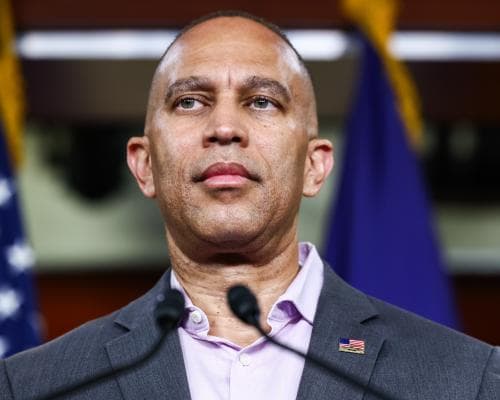
Hakeem Jeffries, the House minority leader, sent a letter to his caucus Tuesday that reads less like a political argument and more like a portfolio defense memo. He called the Massie amendment "overly broad," warning it could accidentally cut humanitarian programs and weaken leverage against Hamas and Hezbollah. Pete Aguilar, the number-three House Democrat, backed him up publicly. Translation: The party establishment is circling the wagons around a $3.3 billion line item that has quietly anchored U.S. Middle East policy — and a lot of defense contractor revenue — for decades.
Here's the mechanical reality. The amendment, proposed by Kentucky Republican Thomas Massie, targets the annual $3.3 billion in Foreign Military Financing that Israel receives under a 10-year memorandum of understanding signed in 2016. That money flows directly to Israeli defense procurement, much of it recycled back to American firms like Lockheed Martin, Boeing, and Raytheon for missiles, bombs, and Iron Dome components. Block the aid, and you don't just tweak a diplomatic relationship — you disrupt a supply chain that touches quarterly earnings reports from Connecticut to California.
The numbers are not trivial. The $3.3 billion represents roughly 16% of Israel's annual defense budget and about 0.5% of total U.S. foreign aid. But in the context of the current appropriations fight, it's a political grenade. Primary voters in New York and Colorado have already ousted Democratic incumbents who were seen as too soft on Israel. Michigan and Missouri primaries loom. The Democratic base — particularly younger, progressive voters — is increasingly unwilling to underwrite the Netanyahu government's military operations in Gaza. Yet the party's leadership is betting that cutting the aid would be worse: it would hand Republicans a cudgel to paint Democrats as anti-Israel, while potentially destabilizing a key regional ally and spooking the defense sector.
For investors, this is a rare window into the machinery of political risk. Defense stocks have been on a tear since the Ukraine war began, with the iShares U.S. Aerospace & Defense ETF up roughly 30% over the past year. But the Israel aid debate introduces a new variable: the possibility that domestic political pressure could force a recalibration of U.S. military commitments. If the Massie amendment somehow passes — unlikely but not impossible — it would send a signal that the era of blank-check defense funding is fraying. More likely, the amendment fails, but the debate itself becomes a recurring feature of budget negotiations, adding volatility to a sector that has enjoyed remarkable stability.
What matters for the wealthy is the second-order effect. A sustained Democratic primary challenge to Israel aid doesn't just threaten a single line item. It reshapes the geopolitical risk premium that investors have baked into Middle East assets for decades. Israeli bonds, shekel-denominated debt, and even Tel Aviv real estate have long traded with an implicit U.S. guarantee. Chip away at that guarantee, and the cost of capital for Israeli companies rises. Meanwhile, American defense contractors face a new headwind: their most reliable export customer might become a political football in every election cycle.
Jeffries and Aguilar are betting they can hold the line. But the trend line is clear. The Democratic coalition is fracturing along generational and ideological lines, and Israel aid is the fault line. For anyone managing capital, the lesson is simple: the $3.3 billion is small, but the signal it sends about the stability of U.S. defense commitments is large. Watch the vote, but more importantly, watch the next primary. That's where the real money story is being written.