The Soloist: Tadej Pogačar’s Relentless Ascent to Five-Tour Glory
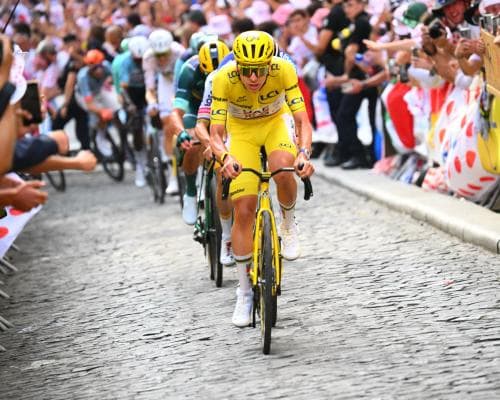
The 2026 Tour de France was supposed to be a battle of titans. Jonas Vingegaard, the stoic Dane. Remco Evenepoel, the rising star. Paul Seixas, the young pretender. For six days, the peloton hummed with anticipation, a coiled spring of potential. Then, with 42 kilometers remaining on stage six, high above the ski village of La Mongie on the Col du Tourmalet, Tadej Pogačar did what he does best: he attacked. Not a probing move. Not a tactical feint. A single, devastating surge that peeled the race apart like a ripe fruit. In that moment, the suspense of the entire Tour evaporated. As former team manager Marc Madiot put it, “There was one single rider who attacked in this Tour: Tadej Pogačar. He attacked once, and everyone understood it was finished.”
To call it a victory is almost reductive. What Pogačar achieved on that Pyrenean climb was something closer to a solo recital—a performance of such surgical precision that the rest of the field became mere spectators. The yellow jersey, cycling’s most coveted prize, was effectively won in a single, 42-kilometer stretch of road. For those of us who follow the sport, it was both breathtaking and, for the neutrals, a little brutal. The art of cycling’s greats, after all, doesn’t merely kill suspense; it eviscerates it. Pogačar, now a five-time Tour winner, joins the pantheon of Jacques Anquetil, Eddy Merckx, Bernard Hinault, and Miguel Induráin. But where those champions often ground down their rivals over weeks, Pogačar’s method is more surgical—a single, unanswerable question asked at the exact moment the answer is final.
This is not luck. It is the product of a machine honed to perfection. Pogačar’s UAE Team Emirates squad operates with the quiet efficiency of a Swiss watchmaker. His training data, his nutrition, his aerodynamics—all are optimized to a degree that would make a Formula 1 engineer nod in approval. But the real magic lies in the instinct. The ability to read a race, to sense the exact moment when the collective will of the peloton wavers, and then to apply pressure so perfectly that the entire structure collapses. It is a kind of craftsmanship that transcends sport. In the world of luxury, we talk about the “hand of the maker”—the telltale signs of a bespoke suit, a hand-wound movement, a vineyard’s single-vineyard cuvée. Pogačar’s attack on the Tourmalet was that: a signature move, unmistakably his, impossible to replicate.
For the collector of rare experiences—the person who owns a Bugatti Chiron not for speed but for engineering, who travels to the Arctic to see the Northern Lights because of the ephemeral nature of the moment—Pogačar’s dominance offers a similar thrill. It is the joy of witnessing something that happens only once in a generation. The green jersey battle between Mads Pedersen and Jasper Philipsen was a classic, a sprinting saga full of elbows and heartbreak. But the yellow jersey? That was a coronation. And in a world where rarity drives value, Pogačar’s ability to win unopposed makes him the ultimate commodity: a champion whose victories are so definitive that they become artifacts of perfection.
What does this say about luxury taste in 2026? That we are drawn to singularity. The ultra-wealthy no longer want just the best; they want the best that is also the rarest, the most unrepeatable. Pogačar’s Tour victory is not a repeat of Merckx’s five—it is a new category altogether. He wins not by attrition but by revelation. Each attack is a statement: I am here, and you are not. It is the same impulse that drives a collector to seek out a single-malt whisky from a closed distillery, or a watch with a movement that took a decade to perfect. There is no substitute for the original.
As the Tour de France moves toward its next chapter, with Seixas and Evenepoel looming as future contenders, one wonders: can anyone stop Pogačar? Perhaps. But for now, the question is irrelevant. What matters is the moment we just witnessed—a rider, a mountain, a single attack that rewrote history. In the curated life, we don’t just follow the race. We savor the artistry. And this year, the artistry was Pogačar’s alone.