The 12-Passenger Catamaran That Turns the English Channel Into a Private Sanctuary
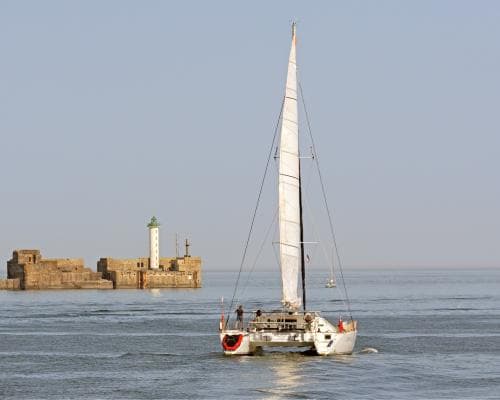
There is a moment, about an hour out of Dover, when the engine cuts and the only sound is canvas catching wind. The white cliffs have dissolved into a soft haze. Your phone has no signal. And the catamaran beneath you is lifting and settling like a slow breath. This is not a ferry. This is an arrival before you arrive.
SailLink launched last summer with a radical premise: cross the English Channel the way people crossed it a century ago—by sail, with purpose, and without the indignity of a terminal queue. The boat carries just twelve passengers. Twelve. That is fewer than the guest list for a private dinner at Le Bernardin. The crossing takes four to five hours, but no one checks a watch. Officials come to the boat to clear documents, so you stroll from the train in Dover, walk fifteen minutes past Georgian terraces to the marina, and step aboard. No lines. No loudspeakers. No duty-free perfume.
Helmsman Chris O’Brien calls it a meditative experience. “People find the water healing,” he says, scanning the horizon from the wheel. He is not selling a commute. He is selling a reset. For the ultra-wealthy, time is the only non-renewable asset. SailLink offers a way to spend that time not in transit, but in transformation. The boat runs from April to mid-September, up to five times a week, and a new Shoreham-to-Fécamp route is in the works. But the real luxury is not the schedule. It is the permission to slow down.
On a recent crossing, passengers helped haul the sails. Among them were Paul and Caroline Docherty, who had cycled from York to London, then down through Kent. “The cycle was hot and unpleasant,” Caroline admitted, “but I’m sold.” Her husband nodded, already planning a future crossing from Hull. Meanwhile, two teenage boys—the kind who usually bury themselves in screens—learned to steer from O’Brien, then sprawled on the nets at the bow, scanning for dolphins. The boat cut a clean course toward Boulogne, and by the time the French coast appeared, everyone aboard had slipped into a gentler rhythm. Tuned into wind and tide. Tuned out of everything else.
This is what wealth increasingly craves: not more speed, but more texture. A private jet gets you there fast, but it seals you off from the journey. A superyacht is a floating palace, but it isolates you from the sea. SailLink offers something rarer—a curated passage that connects you to the elements without sacrificing comfort. The catamaran is largely wind-powered; engines are used only when necessary. It is sustainability as a byproduct of pleasure, not a virtue signal.
Boulogne-sur-Mer rewards the approach. France’s largest fishing port, it is a city shaped by the sea in name and spirit. From the marina, you can pick up ebikes and trace the Vélomaritime cycle path north to Cap Gris-Nez, where the Channel narrows to its slimmest point. The route passes Wimereux’s belle epoque villas, Ambleteuse’s bleach-blond beach, and fields stippled with skylarks. It is a landscape that defies the industrial stereotype of the Pas-de-Calais. You eat baguettes stuffed with gooey cheese while the breeze buffets your face, and you realize: the crossing was not the interlude. It was the point.
For those who can afford to choose how they spend their hours, SailLink is not a transport option. It is a statement. It says that the journey matters as much as the destination. That the best way to arrive in a place shaped by the sea is to let the sea shape your arrival. That luxury, at its highest level, is not about having more. It is about experiencing more—with fewer people, more wind, and no queue.
The Experience
Book a private charter for your group of twelve on SailLink’s Dover-to-Boulogne route, or inquire about the upcoming Shoreham-to-Fécamp trials for an even more bespoke crossing.