Lancashire’s Quiet Comeback: Why Preston and St Helens Are the Next Frontier for the Discerning Traveler
Imagine a journey that fits inside a single room. The French writer Xavier de Maistre once argued that you could travel without leaving your chair. Julio Cortázar turned a staircase into an epic. Now, consider an entire county—Lancashire—offering enough texture, history, and quiet reinvention to fill a lifetime of discovery. For the ultra-wealthy, the real luxury is no longer a private island. It’s the thrill of the unspoiled. The place that hasn’t been Instagrammed to death. The town that is rising, quietly, on its own terms.
Preston and St Helens are those places. Two northern powerhouses, once the engines of the Industrial Revolution, now staging a subtle but serious comeback. Preston, made a city in 2002, has poured £45 million into a new leisure complex, a revamped museum, and a bridge over the River Ribble. St Helens, my childhood town—proudly Lancastrian but administered as Merseyside—feels like a drawing board: demolition and redesign happening in plain sight. This is not a glossy brochure. It’s a real, raw, and deeply compelling narrative of regeneration. For the collector of experiences, this is the ultimate acquisition: a place that is becoming, not one that has already arrived.
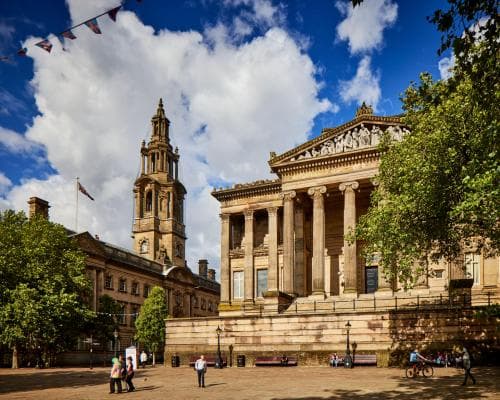
Craftsmanship here is not about a hand-stitched leather bag. It’s about the hypodermic spire of St Walburge’s church—the tallest parish church in the UK, designed by Joseph Hansom, the man who gave us the Hansom cab. It’s about the Harris museum and gallery, which reopened after a £19 million refurbishment. Inside, you’ll find art, local history, textiles, fashion, ceramics—and perhaps the most compelling argument for a rainy-day refuge in the North. The Harris is a regional treasure, housing the Cuerdale hoard, the largest Viking hoard ever found in England, unearthed beside the Ribble. (One might politely suggest the Ashmolean and British Museum consider returning it.) The craftsmanship is in the brutalist bus station and Guild Hall, built for an unrealized new town. It’s in the monument to the 1842 martyrs, gunned down during the General Strike. Every brick tells a story of ambition, loss, and resilience.
What does this signal about wealth and taste? The old guard buys a chalet in Gstaad. The new guard buys a stake in a place that has soul. Preston and St Helens offer something that money cannot manufacture: authenticity. The ultra-wealthy are increasingly seeking destinations that are not curated for them. They want the friction of a working town, the surprise of a brutalist landmark, the quiet dignity of a Victorian market hall. This is not about escapism. It’s about immersion. It’s about standing beneath a hypodermic spire and looking up—an act that, as I discovered, is primitive cognitive therapy. It’s about walking from the park-and-ride to the crown court and turning a commute into a sightseeing tour. Winckley Square with its Georgian terraces. Saint Alphonsa Syro-Malabar Cathedral. The Miller Arcade. These are not tourist traps. They are living, breathing spaces of power and influence.
Looking forward, the question is not whether these towns will rise. They already are. The question is whether the world will catch on before they lose their edge. Richard Arkwright, father of the factory system, was born here in 1732. Centenary Mill was built for Horrockses, Crewdson & Co—a textile firm that once spanned an empire. The same spirit of invention is now turning Preston and St Helens into laboratories of urban renewal. For the traveler who has seen it all, this is the final frontier. Not a destination. A discovery. And the best part? You don’t need a passport. Just a willingness to look beyond the frayed fabric and see the silk underneath.
The Experience
Arrange a private tour of Preston's Harris Museum and St Walburge's spire, followed by a curated walk through Winckley Square and a tasting menu at a restored Victorian market hall.