The New Calculus of the Channel: What the Ultra-Wealthy Can Learn from the Surveillance State
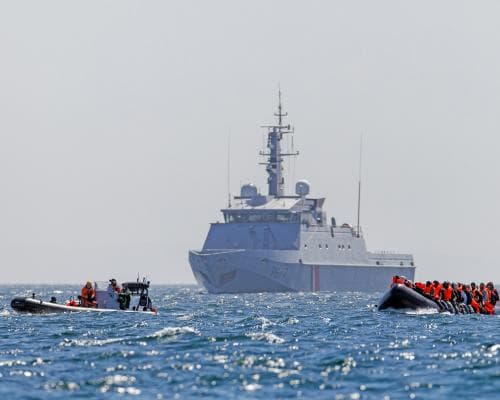
On a gray Sunday morning in Dover, the kind of morning that makes the sea look like hammered pewter, Andy Burnham stood in a room that feels less like a government office and more like the bridge of a warship. Screens flickered with thermal imaging, drones hummed in the distance, and somewhere in the gray expanse, a rubber boat carrying thirty souls was making its way toward the white cliffs. The Prime Minister's visit was not about yachts. But for anyone who has ever watched a 60-meter Feadship glide through those same waters, the scene was a stark reminder: the English Channel is no longer just a playground for the leisure class. It has become a theater of control, and the ultra-wealthy are watching closely.
The numbers tell a story of disruption, if not triumph. Small boat crossings are down 43% compared to the same period last year—from 21,690 to 12,469. That is not a rounding error; that is a seismic shift in the logistics of illegal migration. But as any collector of rare assets knows, a falling market is not a dead market. In the past week alone, more than 1,000 people have arrived, with 752 arriving in nine boats on a single day—the highest single-day tally of the year. The smugglers, like the most adaptable of traders, are simply waiting for the right weather window, the right tide, the right blind spot. And when they move, they move with the precision of a well-timed auction bid.
For the maritime connoisseur, the Channel has always been a place of paradox. It is at once the most policed and the most porous of waters. The same surveillance drones that track a dinghy overloaded with migrants can, and do, track a 100-meter superyacht on its way to Monaco. The technology is agnostic. What has changed is the political will to deploy it. The joint command room in Dover, once a sleepy outpost, is now a nerve center of real-time data, thermal cameras, and predictive algorithms. For the owner of a 40-knot chase boat, this means one thing: privacy is a luxury that must be bought, not assumed. The days of anonymous passage are over. The Channel is now a glass floor, and everyone walks on it.
But the deeper story here is not about boats or migrants. It is about the nature of control itself. The UK government's strategy—drones, bilateral deals with France, and a rhetoric of 'relentlessness'—has not destroyed the smugglers' business model; it has merely raised the cost of entry. The same is true in the world of high-end yachting. As ports tighten their security, as AIS transponders become mandatory, as crew background checks become the norm, the cost of owning a vessel that can slip through the cracks has skyrocketed. This is not a bad thing. Scarcity, after all, is what makes a thing precious. A yacht that can be tracked by a drone is a yacht that is safe. A yacht that cannot be tracked is a liability. The market is slowly, inexorably, moving toward the former.
What does this mean for the collector? It means that the next great investment in maritime luxury is not a new hull design or a larger infinity pool. It is cybersecurity. It is encrypted communications. It is a captain who understands not just the weather, but the political weather. The same data streams that allow the Dover command room to predict a migrant crossing can be used to predict a pirate attack, a customs inspection, or a diplomatic incident. The ultra-wealthy are beginning to understand that their vessels are not just toys; they are floating embassies, subject to the same geopolitical currents as any other asset. The smart money is not on the biggest yacht, but on the best-informed one.
As Burnham promises to 'bring back control,' the irony is not lost on those who have always controlled their own passage. The Channel, once the province of the daring and the discreet, is now a laboratory for the future of maritime governance. And that future is one of transparency, surveillance, and, ultimately, safety. For the yachting class, this is not a threat. It is an invitation. An invitation to rethink what it means to travel well, to be seen, and to be safe. The boats may be smaller, but the stakes have never been higher. And in that, there is a strange, quiet elegance.