The Art of the Breakaway: Kim Le Court’s Masterclass in Grit and Grace
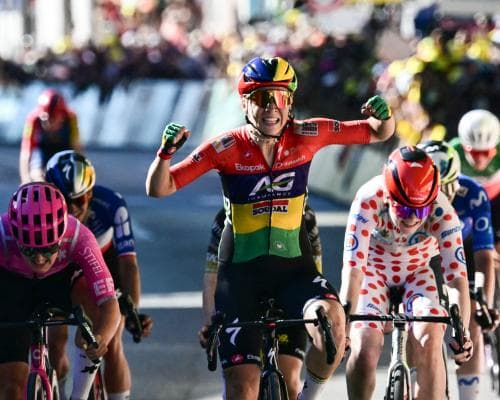
There is a moment in every great race when the script tears, and only the truly composed can rewrite it on the fly. For Kim Le Court, that moment came on the descent of the second-to-last climb of stage six of the Tour de France Femmes, a sinuous ribbon of asphalt that seemed to mock her ambitions. A mechanical failure—a cruel, unglamorous twist—forced her off her trusted machine and onto a spare, while the peloton surged ahead. Most would have watched their chances evaporate. Le Court, instead, treated it as a mere comma in her sentence.
What followed was a lesson in the kind of controlled aggression that separates the memorable from the merely competitive. The 29-year-old Mauritian, riding for AG Insurance-Soudal, clawed her way back with a ferocity that left the chasing group breathless, then launched a breakaway that would hold to the line. Her victory was not just a win; it was a statement—that in the rarefied air of professional cycling, the difference between triumph and tragedy is often measured in seconds, and in the willingness to ignore the odds.
Le Court’s stage win, her first at the Tour de France Femmes, was a masterclass in the sport’s brutal arithmetic. The stage, a rolling 112-kilometre test through the foothills of the Alps, was raced at a furious pace, with the yellow jersey group trading blows like prize fighters. The final standings tell the tale of a race still very much alive: Marlen Reusser (Movistar) holds the overall lead by a razor-thin 12 seconds over Demi Vollering (FDJ-Suez), with Katarzyna Niewiadoma (Canyon/SRAM) lurking just over a minute back. Le Court’s bonus seconds—24 in total, a testament to her relentless attacking—lifted her to ninth overall, a position that now makes her a genuine threat for the podium as the race heads toward the monstrous Mont Ventoux.
For those who follow the mechanics of cycling as closely as the aesthetics, Le Court’s performance was a reminder that the sport’s true luxury lies in its unpredictability. Her mechanical, a moment of high drama that could have ended her day, was neutralised by the swift work of her team—a choreography of spare wheels and calm voices that spoke to the kind of investment top squads make in the margins. It is this invisible infrastructure, the logistics and the human capital, that often decides races before the final sprint. And Le Court’s ability to stay patient after such a massive effort, to resist the urge to over-extend, was a display of the emotional intelligence that marks the sport’s greats.
The broader context is equally compelling. This Tour de France Femmes, now in its fourth edition, has become a fixture on the global sporting calendar, drawing record crowds and, crucially, the attention of luxury sponsors who see the women’s peloton as the next frontier. The teams are better funded, the equipment more refined, and the competition deeper than ever. Ferrand-Prévot’s post-race remark—'Full gas all day long'—captures the new ethos: no longer a secondary event, but a spectacle in its own right, with its own heroes and its own dramas.
Le Court’s victory, then, is more than a personal milestone. It signals a shift in the taste of the cycling connoisseur, who now looks to the women’s race for the same blend of daring and precision that once defined the men’s classics. Her story—a rider from Mauritius, a nation not traditionally associated with the Alps—adds a cosmopolitan flair to the narrative, reminding us that excellence is not confined to the traditional European powerhouses.
As the race rolls toward Mont Ventoux, the so-called 'Giant of Provence,' the standings are poised on a knife’s edge. Reusser’s lead is fragile; Vollering’s form is ominous; and Le Court, now with the confidence of a stage win, will be a marked woman. The next few days will test not just the legs, but the nerve. And if stage six was any indication, we are in for a finale that will be talked about for years—not for the statistics, but for the sheer, unscripted beauty of a rider who refused to let a mechanical define her day. In the world of the ultra-wealthy, where every detail is curated and controlled, there is a lesson here: the most memorable moments are often the ones that go off-script. Le Court, with her victory, has given us one such moment, and it is worth savouring.