The Silent Wingfall: Bird Flu Reaches Australia's Wild Coast
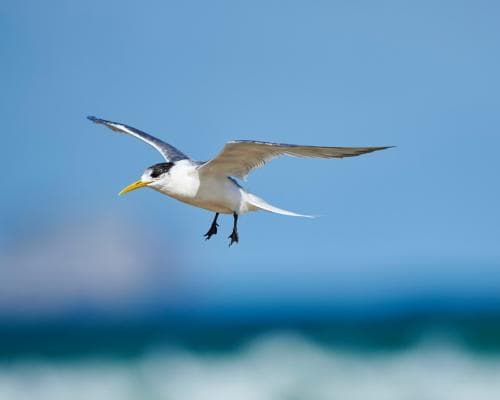
The helicopter's shadow skims over Baudin Rocks, a scatter of granite and guano off South Australia's Limestone Coast, and what it reveals is not a scene from nature documentaries but a quiet apocalypse. Forty-nine greater crested terns lie dead on the rocks; another 35 are too weak to lift their heads. Within days, the tally climbs past 80. This is the first suspected mass mortality event from the H5N1 bird flu virus on Australian soil—a disease that, until six weeks ago, had never touched this island continent. For the ultra-wealthy traveler who has come to the Southern Ocean for the world's most exclusive wildlife encounters, the message is stark: the birds are dying, and the silence is spreading.
Baudin Rocks is not a place you stumble upon. It is a speck on the map, accessible only by helicopter or a skilled skipper willing to navigate the Southern Ocean's moods. The greater crested tern, with its black cap and coral-red bill, is the sentinel of these waters—a bird so abundant that its absence is the first sign of trouble. And trouble has arrived. South Australia's chief vet, Skye Freuan, confirmed that the virus is likely the culprit, and that there is 'nothing we can do' to stop it. For the luxury safari operator, this is a moment of reckoning. The high-end traveler who once paid a premium to watch these terns dive-bomb the surf now faces a different kind of privilege: witnessing the last days of a species' abundance.
The virus is not staying put. Three more suspected cases have emerged inland, near Monarto, where poultry farms cluster like nervous neighbors. Silver gulls, those opportunistic scavengers of the shoreline, have also tested positive, including one confirmed by the CSIRO. This is how a coastal outbreak becomes a continental crisis. Jack Gough of the Invasive Species Council compares it to South America's trajectory—early detections, then a rapid, terrifying acceleration. 'We are still at the very early stages,' he warns, 'but this could escalate quickly.' For the traveler, this means the classic Australasian safari—the one that promised penguins, albatross, and terns in abundance—is now a race against time. The question is no longer where to go, but what will still be there when you arrive.
This is the new luxury: access to the wild before it vanishes. The ultra-wealthy have long paid for exclusivity—a private lodge in the Okavango, a chartered yacht in the Galápagos. But the rarest commodity now is a living bird. The H5N1 outbreak has turned the Southern Ocean into a high-stakes viewing ground, where the presence of a healthy tern colony is worth more than any five-star suite. Helicopter tours that once offered panoramic views of the coast now serve as reconnaissance missions, counting casualties. The price of a seat on such a flight is not just money; it is the emotional toll of watching a mass mortality event unfold in real time.
For those who still wish to travel, the season is short and the rules are strict. Biosecurity protocols now govern every landing on offshore islands. Visitors must disinfect boots, avoid contact with any bird, and report any sign of sickness. The luxury safari operator's role has shifted from guide to guardian, and the experience is more like a wildlife hospital visit than a holiday. Yet there is a strange allure in this. The traveler who ventures to Baudin Rocks now is not a tourist but a witness—one who will return home with a story not of majestic flocks, but of a species' final stand.
What does this signal about the future of luxury travel? The pandemic taught the wealthy to value open spaces; bird flu is teaching them to value living things. The next frontier is not a new island or a hidden valley, but the preservation of what remains. Operators are already pivoting to 'conservation safaris,' where proceeds fund surveillance and research. The price of such a trip is steep—often $5,000 per day—but the dividend is the chance to say, 'I was there before it was gone.'
Where will the wealthy go next? Not to the Galápagos, where the virus is already feared. Not to Antarctica, where penguin colonies are at risk. Instead, they will follow the birds to the last refuges—the remote archipelagos of the Pacific, the windswept shores of Patagonia, the cliffs of New Zealand. But for now, the most profound journey is here, in South Australia, where a helicopter flight over Baudin Rocks offers a glimpse of the future: a world where the rarest sight is a bird taking flight.