Rabat’s Quiet Reign: Why the World’s Most Discerning Travelers Are Turning to Morocco’s Capital of Culture
There’s a moment every collector knows: the instant a thing you’d never considered becomes the only thing you want. For me, it was a dog-eared paperback in a staffroom above a barbecue restaurant in Portsmouth. Bridget Jones’s Diary. I was nineteen, more interested in football and the boy in the year above than in any page. But that book—flimsy, funny, utterly unpretentious—turned me into a reader. I cancelled nights out to stay in with it. My mother thought I was depressed. I was, in fact, falling in love. That’s the power of a story, and it’s the same force that draws the world’s wealthiest to a city that has just been crowned 2026 UNESCO World Book Capital: Rabat.
Not Marrakech. Not Casablanca. Rabat—Morocco’s quiet, sun-washed capital, perched between those two better-known names like a private member’s club on a crowded beach. It was made the capital in 1912, under French rule, and the Ville Nouvelle still wears its Parisian tailoring: wide boulevards, cream facades, a sense of order that feels almost aristocratic. But the real treasure lies a short walk from the central station, where the solar-powered Mohammed VI Museum of Modern and Contemporary Art houses Shifting Horizon(s), a permanent exhibition that redefines North African art. There, you’ll find Mohamed Melehi’s abstract waves—paintings that feel like the ocean’s secret signature—and Lalla Essaydi’s Bullet Revisited, a photograph of a woman draped head to toe in gold bullets. It’s a stunning, unsettling meditation on violence and beauty, the kind of work that makes you pause mid-step, the way a rare vintage makes you stop talking.
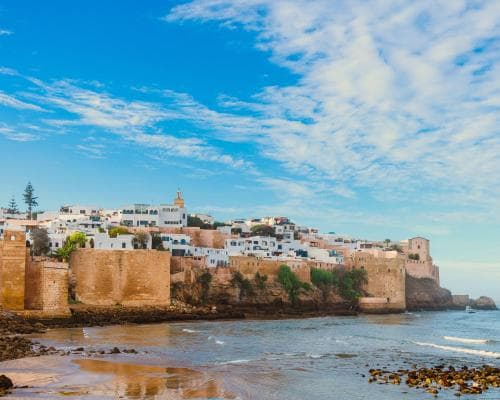
But Rabat’s true rarity is its medina. Unlike the frenetic souks of Marrakech, where every stall is a performance, Rabat’s old city is a labyrinth of mint, slippers, strawberries, and sabon beldi—a black olive soap that feels like silk in the hand. No one harasses you. No one insists you sample a sardine. The customer service is, as one visitor noted, uncannily French: you are left to wander, invisible, free. That’s the luxury of being left alone, and Rabat offers it in spades. Follow the scent of salt air to the Kasbah of the Oudayas, a district of low whitewashed houses that seems to have been painted by Matisse. It’s a place where the Atlantic crashes below and the streets are so quiet you can hear your own footsteps—the sound of money not needing to announce itself.
This is what Rabat signals about wealth in 2026: the new status symbol isn’t a private island or a hypercar. It’s literacy. It’s the ability to say you’ve come to the world’s book capital not for a photo op, but for a feeling. The UNESCO designation, paired with the UK’s National Year of Reading, has turned Rabat into a pilgrimage site for those who understand that culture is the ultimate asset. And the city delivers. The bookshops are small, curated, and filled with volumes in French, Arabic, and English. The cafés are the kind where you can sit for hours with a novel and a mint tea, watching the light change over the Bouregreg River. There’s a reason the ultra-wealthy are trading Marrakech’s chaos for Rabat’s composure: it’s the difference between a first-class lounge and a private jet. Both get you there, but only one leaves you feeling like you’ve discovered something no one else knows.
For those who make the trip, the experience is not about ticking a box. It’s about the slow, deliberate pleasure of a city that rewards patience. Start at the museum, then lose yourself in the medina. Buy a bar of sabon beldi from a woman who’s been making it for decades. End at the Kasbah at sunset, where the Atlantic turns to gold. And if you’re lucky, you’ll find a book—perhaps a dog-eared copy of something you’d never have chosen—that changes your life. That’s the real luxury. It has nothing to do with price and everything to do with timing. Rabat is the moment. Be there before the rest of the world catches on.
The Experience
Book a private, guided literary tour of Rabat through a luxury travel concierge—or charter a jet to Casablanca and let a local fixer lead you through the medina’s hidden bookshops and artist studios.